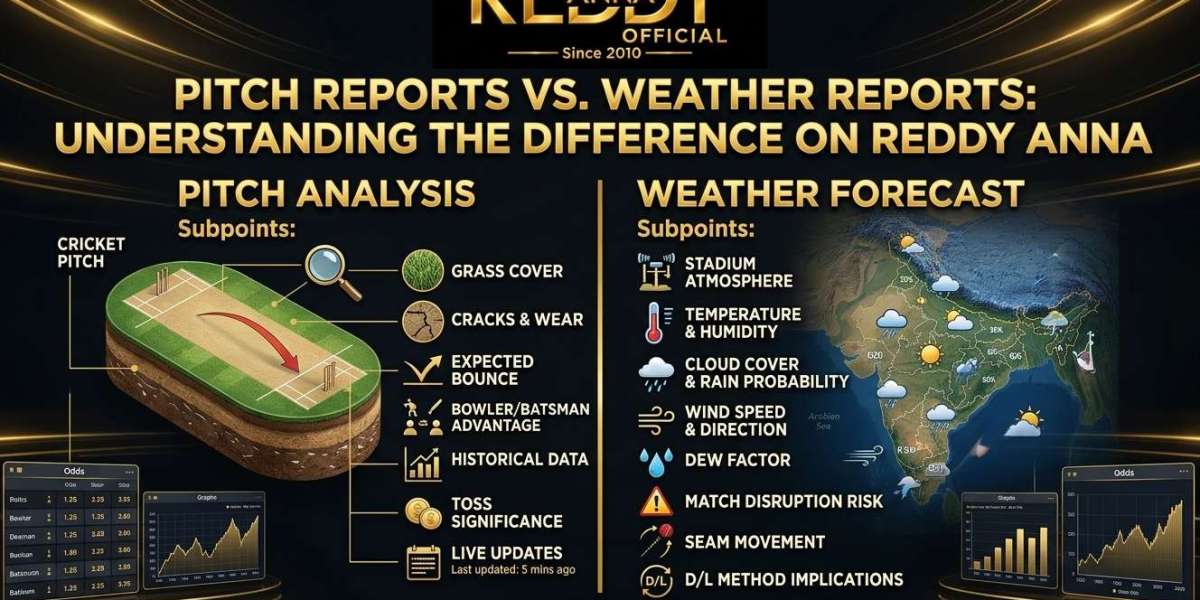

Cricket matches depend on several factors, and playing conditions can influence how teams approach a game. On Reddy Anna, understanding the difference between pitch reports and weather reports helps readers interpret match information more clearly. Although both reports describe conditions surrounding a match, they focus on different aspects of the game. A pitch report explains the playing surface, while a weather report covers atmospheric conditions such as rain, temperature, and humidity.
What Is a Cricket Pitch Report?
A pitch report describes the condition and characteristics of the surface on which players compete. Before a match, commentators and analysts often discuss the pitch to explain how it might affect batting, bowling, and team selection.
A pitch report generally covers:
Surface condition: Whether the pitch looks dry, damp, cracked, or covered with grass.
Pace and bounce: How the ball might behave after hitting the surface.
Spin assistance: Whether the conditions could help spin bowlers grip and turn the ball.
Batting conditions: Whether the surface appears suitable for stroke-making or may challenge batters.
Wear and tear: How the pitch could change as the match progresses.
However, these observations do not guarantee a particular outcome. Actual playing conditions can change, and individual performances also influence the result.
What Is a Cricket Weather Report?
A weather report explains the atmospheric conditions expected at the venue before or during a match. Unlike a pitch report, it focuses on the surrounding environment rather than the playing surface.
A cricket weather report usually includes:
Rain probability: The likelihood of rainfall during the scheduled playing period.
Temperature: The expected warmth or coolness at the venue.
Humidity: The amount of moisture present in the air.
Wind conditions: Wind speed and direction, which may influence certain deliveries.
Cloud cover: The extent of cloudiness, which can affect visibility and may accompany changing weather conditions.
Weather forecasts help readers understand possible interruptions and changes in playing conditions. Nevertheless, forecasts can change, so checking updated information is more useful than relying on an earlier prediction.
Pitch Reports vs Weather Reports: Key Differences
The main difference lies in what each report measures. A pitch report examines the surface, whereas a weather report examines the atmosphere around the venue.
1. Focus of the report
Pitch reports explain surface characteristics, including bounce, grip, and pace. Weather reports describe rain, wind, temperature, and cloud cover.
2. Influence on team strategy
A dry surface may encourage a team to consider spin options, depending on the pitch and match format. Similarly, a surface offering consistent bounce may support particular batting or bowling plans. Weather conditions can also influence decisions, especially when rain threatens to shorten the game.
3. Changes during a match
A pitch can gradually deteriorate because of footmarks, wear, and repeated use. Weather conditions, meanwhile, can change within minutes as clouds gather, rain begins, or the wind strengthens.
4. Reliability of predictions
Neither report guarantees how a match will unfold. Pitch assessments rely on observations and experience, while weather reports use forecasts that may change. Therefore, readers should treat both as useful information rather than definite predictions.
How Can Pitch and Weather Conditions Affect Cricket Matches?
Pitch and weather conditions can influence different parts of a cricket match. Understanding their combined effect provides a more complete picture of the challenges teams may face.
For example, a dry pitch might offer grip to spinners, while high humidity or cloud cover could lead commentators to discuss the possibility of movement for fast bowlers. However, humidity and cloud cover alone do not confirm that the ball will swing. The ball, surface, wind, and bowling technique also matter.
Rain presents a separate challenge. It can delay the start, interrupt play, or reduce the available overs. In limited-overs cricket, officials may apply the Duckworth–Lewis–Stern (DLS) method when the competition's rules require a revised target after an interruption.
Readers exploring Reddy Anna sports information should distinguish between these factors rather than assuming that one condition determines the result. A team must adapt to the actual situation as the match develops.
Where Should You Check Match Conditions Before a Game?
Reliable information starts with the right sources. Before drawing conclusions about a fixture, compare the latest pitch assessment with a current forecast for the venue.
Consider these practical steps:
Check the venue and match start time to ensure the information relates to the correct fixture.
Review recent weather forecasts, especially when rain could interrupt play.
Look for updates from official cricket boards, tournament organisers, and established weather services.
Read the pitch assessment alongside team news and recent performances.
Recheck conditions near the toss, because new information may change the initial assessment.
If you use a Reddy Anna ID to access an online account, verify that the page you visit is legitimate and avoid sharing credentials through unverified links. The Reddy Anna login process should remain separate from your assessment of cricket conditions.
Similarly, the Reddy Anna app may provide account-related access, but readers should confirm whether current match information is available there rather than assuming every feature exists. Search results mentioning Reddy Anna official or Reddy Anna book club should also be checked carefully to establish whether they refer to the intended service.
Common Mistakes to Avoid When Reading Reports
Even useful reports can lead to incorrect conclusions when readers overlook important details.
Confusing cloud cover with guaranteed swing: Clouds do not automatically make the ball swing. Other conditions and the bowler's technique influence movement.
Treating a pitch report as a result prediction: A favourable batting surface does not guarantee a high score. Batting quality, bowling execution, and match circumstances remain important.
Ignoring changing conditions: An early forecast may not reflect the weather at the scheduled start. Updated reports provide a more current picture.
Relying on a single observation: A balanced assessment considers the pitch, weather, team composition, and format together.
Conclusion
Pitch reports and weather reports serve different purposes in cricket analysis. A pitch report explains how the playing surface may affect batting and bowling, while a weather report highlights conditions such as rain, wind, and temperature. Understanding both helps readers interpret match updates with greater accuracy. On Reddy Anna, the most useful approach is to compare current, reliable information and remember that conditions can influence a game without determining its final outcome.