
In today’s digital business environment, technology plays a central role in almost every operation. Businesses depend on computers, networks, cloud applications, servers, communication tools, websites, and business software to serve customers and manage daily activities. When these systems stop working, even for a short period, productivity can quickly decline.
Business downtime occurs when employees, customers, or business processes cannot access the technology and services they need. Downtime can be caused by hardware failures, network problems, software errors, cyberattacks, power interruptions, human mistakes, or cloud service issues. Without proper preparation, a small technical problem can become a major operational disruption.
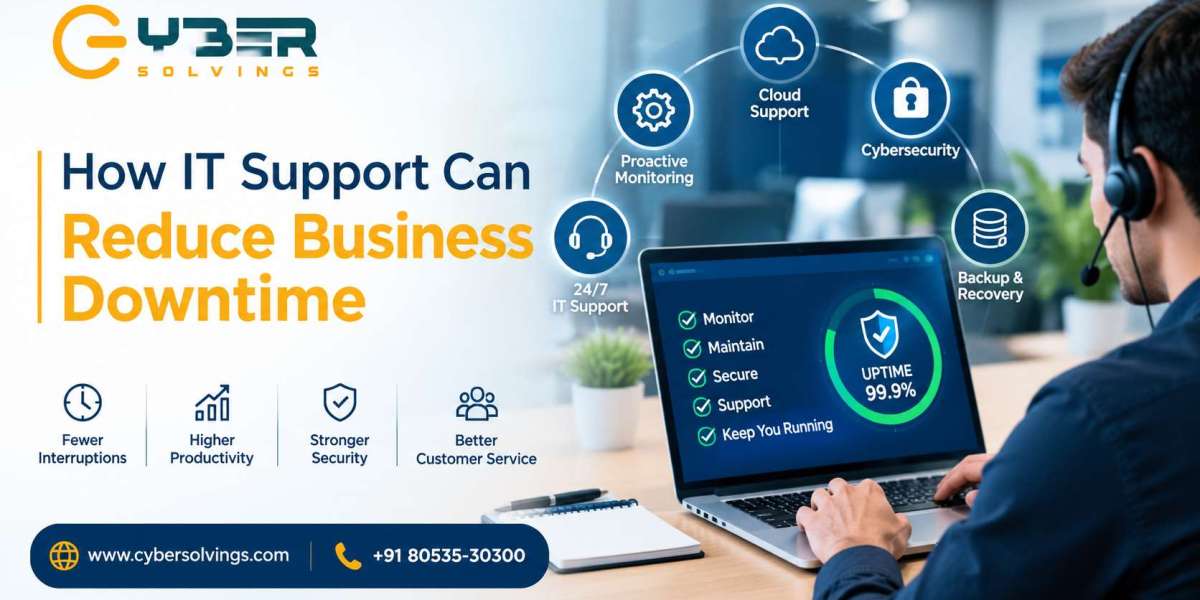
This is where professional IT support becomes important. Instead of waiting for systems to fail, businesses can use proactive IT support to monitor infrastructure, identify problems early, maintain devices, improve cybersecurity, manage backups, and respond quickly when incidents occur.
For businesses looking to improve reliability and minimize interruptions, Cybersolvings provides IT-focused solutions designed to help organizations maintain stable and secure technology environments.
What Is Business Downtime?
Business downtime is a period when an important system, application, network, device, or business service is unavailable or unable to perform normally.
For example, a business may experience downtime when:
Employees cannot access the company network.
A server stops responding.
Business software becomes unavailable.
Internet connectivity fails.
A website goes offline.
Files become inaccessible.
A cyberattack disrupts systems.
Hardware suddenly fails.
Cloud applications become unavailable.
Data is accidentally deleted or corrupted.
Downtime does not always mean that an entire business shuts down. Sometimes only one department or essential process is affected. However, even limited downtime can create delays and reduce employee productivity.
Modern business continuity planning focuses on preparing organizations to continue operating during failures and recovering critical systems after disruptions.
Why Is Downtime a Serious Problem for Businesses?
The impact of downtime goes beyond a technical inconvenience. When employees cannot access the systems they need, business operations can slow down immediately.
1. Lost Productivity
Employees rely on computers, internet connections, cloud applications, email, databases, and collaboration platforms. When these systems are unavailable, employees may be unable to complete their responsibilities.
Even when employees remain at their desks, they may spend valuable time waiting for systems to become available or trying to find temporary solutions.
2. Delayed Customer Service
Customers expect businesses to respond quickly. If customer databases, communication systems, websites, or order-processing applications are unavailable, service can be delayed.
Repeated technical disruptions can also affect the overall customer experience.
3. Lost Revenue Opportunities
Downtime can prevent businesses from processing transactions, accepting orders, communicating with customers, or completing important operations.
For businesses that rely heavily on online services, even a short interruption can affect sales and customer activity.
4. Increased Recovery Costs
Emergency repairs can be more expensive than preventive maintenance. Businesses may need urgent technical assistance, replacement hardware, data recovery, or additional resources to restore normal operations.
5. Data and Security Risks
Some downtime incidents are caused by cybersecurity threats. Ransomware, compromised accounts, malware, and other attacks can disrupt operations while potentially putting sensitive information at risk.
This makes cybersecurity an important part of any downtime-reduction strategy.
How IT Support Helps Reduce Business Downtime
Professional IT support takes a proactive approach to technology management. Instead of only fixing problems after they occur, IT teams can continuously monitor systems, maintain infrastructure, identify risks, and prepare recovery solutions.
Here are some of the most important ways IT support can reduce business downtime.
1. Proactive IT Monitoring
One of the most effective ways to prevent downtime is to identify problems before they become serious.
IT monitoring tools can track the performance and health of important systems, including:
Servers
Network devices
Computers
Storage systems
Cloud environments
Applications
Internet connections
Security systems
Monitoring can identify warning signs such as high resource usage, storage limitations, unusual network activity, or system errors.
Modern monitoring and alerting practices are designed to provide early signals of potential failures and help IT teams respond proactively.
Instead of discovering a problem when employees arrive at work and cannot access a system, an IT team may be able to identify and address the issue earlier.
2. Preventive Maintenance
Regular maintenance helps keep IT infrastructure reliable.
Without maintenance, outdated software, insufficient storage, configuration problems, hardware degradation, and other issues can gradually increase the risk of failure.
IT support teams can schedule maintenance activities such as:
Operating system updates
Software updates
Security patches
Hardware health checks
Storage monitoring
Network configuration reviews
Firmware updates
System optimization
Preventive maintenance allows businesses to address smaller problems before they develop into larger outages.
3. Faster Troubleshooting and Incident Response
When an IT problem occurs, response time matters.
A professional IT support team can follow established troubleshooting and incident-response procedures instead of starting from scratch every time a problem occurs.
A structured response can include:
Identifying the affected system.
Determining the cause of the problem.
Assessing the business impact.
Prioritizing critical services.
Applying a solution or workaround.
Restoring affected systems.
Verifying that systems are functioning correctly.
Documenting the incident.
Managed IT environments commonly use metrics such as Mean Time to Detect (MTTD) and Mean Time to Repair/Resolve (MTTR) to understand how quickly issues are identified and resolved.
4. Reliable Backup and Disaster Recovery
Backups are an essential component of downtime protection.
If important files or systems are lost because of hardware failure, accidental deletion, malware, ransomware, or another incident, reliable backups can provide a way to recover.
However, simply creating backups is not enough. Businesses should also verify that backups can actually be restored.
A strong backup and recovery strategy may include:
Automated backups
Off-site or cloud backups
Appropriate backup retention
Secure backup storage
Backup monitoring
Regular restore testing
Disaster recovery procedures
Microsoft's reliability guidance distinguishes backups from automatic failover and notes that backups can help recover from disasters and data corruption.
For organizations, the goal should not simply be “Do we have a backup?” but rather “Can we recover the information and systems we need within an acceptable timeframe?”
5. Stronger Cybersecurity
Cybersecurity is closely connected to business continuity.
A successful cyberattack can prevent employees from accessing systems, encrypt business files, compromise accounts, or interrupt critical services.
IT support can help reduce these risks through measures such as:
Security patch management
Endpoint protection
Firewall management
Access controls
Password policies
Multi-factor authentication
Security monitoring
Email security
Employee security awareness
Threat detection
Cybersecurity should be treated as an ongoing process rather than a one-time installation of security software.
When security controls and monitoring are integrated into everyday IT management, businesses can improve their ability to detect and respond to potential threats.
6. Network Management and Optimization
A reliable network is essential for modern businesses.
Employees may depend on the network to access cloud applications, shared files, business software, communication tools, and online services.
IT support can monitor and maintain:
Routers
Switches
Firewalls
Wi-Fi networks
Internet connections
VPNs
Network traffic
Network performance
IT teams can identify bottlenecks, configuration issues, connectivity problems, and capacity limitations before they cause widespread disruption.
For businesses where internet connectivity is critical, appropriate redundancy and backup connectivity can also be considered as part of continuity planning.
7. Hardware and Software Management
Hardware failures can cause unexpected downtime.
Computers, storage drives, network devices, servers, and other equipment can eventually experience performance problems or failure.
IT support can help businesses monitor device health and plan equipment replacements before critical hardware reaches the point of failure.
Software management is equally important. Unsupported or outdated applications may introduce security and compatibility issues.
Maintaining an accurate inventory of hardware and software helps IT teams understand what technology is being used and where potential risks exist.
8. Cloud and Remote IT Support
Many businesses now depend on cloud-based applications and remote work technologies.
While cloud services can provide flexibility and scalability, businesses still need appropriate management and support.
IT support can assist with:
Cloud account management
User access
Security settings
Cloud application troubleshooting
Remote employee support
Device configuration
Data protection
Connectivity issues
Remote IT support can also allow technicians to troubleshoot many problems without waiting for an onsite visit, potentially reducing the time required to restore affected users.
Proactive IT Support vs. Reactive IT Support
There is an important difference between proactive and reactive IT support.
Reactive IT support generally responds after a problem has already occurred.
For example:
A server fails → employees report the issue → IT investigates → repairs begin.
With proactive IT support, the focus is on identifying and addressing risks before they cause significant disruption.
For example:
Monitoring detects a server issue → IT investigates → the problem is resolved before employees experience a major outage.
This does not mean proactive IT support can prevent every possible outage. Hardware can fail unexpectedly, internet providers can experience interruptions, and major incidents can occur outside a company's control.
The objective is to reduce preventable downtime, detect problems earlier, and improve recovery when disruptions occur.
Business Continuity and IT Support
Business continuity is broader than simply keeping computers running.
It involves preparing the organization to continue important operations during disruptions and recover afterward.
An effective continuity strategy should identify:
Which systems are business-critical
Which services need to be restored first
How much data the business can afford to lose
How quickly systems need to be recovered
Who is responsible for responding
How employees will communicate during an incident
What backup systems are available
Two useful concepts are Recovery Time Objective (RTO) and Recovery Point Objective (RPO).
RTO refers to the target time within which a system or service should be restored.
RPO refers to the amount of data loss, measured in time, that an organization is prepared to tolerate.
These objectives help businesses design recovery strategies according to their actual operational requirements.
How Cybersolvings Can Help Businesses Reduce Downtime
At Cybersolvings, the focus is on helping businesses build reliable, secure, and well-managed IT environments.
A proactive IT support strategy can help organizations with areas such as:
IT system monitoring
Technical troubleshooting
Network management
Cybersecurity
Software and security updates
Backup management
Disaster recovery planning
Hardware and software support
Remote IT assistance
Ongoing IT maintenance
The exact IT requirements vary from one organization to another. A small business may need dependable endpoint, network, backup, and cloud support, while a larger organization may require more comprehensive monitoring, security, redundancy, and recovery planning.
The important principle is to identify the systems that are most important to business operations and build appropriate protection and recovery processes around them.
For more information about IT solutions and support services, visit www.cybersolvings.com.
Practical Steps Businesses Can Take to Reduce Downtime
Businesses can improve IT reliability by following a structured approach.
Step 1: Identify Critical Systems
Determine which applications, devices, networks, and data are essential for daily operations.
Step 2: Monitor IT Infrastructure
Use monitoring tools to identify performance problems and potential failures early.
Step 3: Keep Systems Updated
Apply security patches, software updates, and firmware updates according to an appropriate maintenance schedule.
Step 4: Protect Business Data
Use reliable, secure backups and regularly verify that important information can be restored.
Step 5: Strengthen Cybersecurity
Use appropriate security controls, access management, endpoint protection, and employee awareness practices.
Step 6: Create a Recovery Plan
Document what should happen when critical systems fail and establish responsibilities for responding to incidents.
Step 7: Test the Plan
A recovery plan should not exist only as a document. Regular testing can reveal weaknesses before a real emergency occurs. IT continuity guidance recommends regular testing so organizations can verify recovery capabilities and address shortcomings.
Conclusion
Business downtime can affect productivity, customer service, revenue, data availability, and overall operations. While no organization can eliminate every possible technology failure, businesses can significantly improve their ability to prevent, detect, and recover from IT disruptions.
IT support plays an important role in this process. Through proactive monitoring, preventive maintenance, cybersecurity, network management, backup solutions, disaster recovery planning, and rapid technical response, businesses can create a more reliable technology environment.
The key is to move beyond a purely reactive approach. Instead of waiting for systems to fail, organizations can continuously monitor and maintain their IT infrastructure while preparing for potential disruptions.
With the right strategy and professional assistance from Cybersolvings, businesses can strengthen IT reliability, minimize avoidable interruptions, and create a technology environment that supports day-to-day productivity and long-term business continuity.
Frequently Asked Questions (FAQs)
1. How does IT support reduce business downtime?
IT support reduces downtime by monitoring systems, performing preventive maintenance, addressing technical problems early, managing cybersecurity, maintaining backups, and providing faster troubleshooting when incidents occur.
2. What are the main causes of business downtime?
Common causes include hardware failure, software problems, network outages, cybersecurity incidents, power interruptions, cloud service disruptions, human error, and data loss.