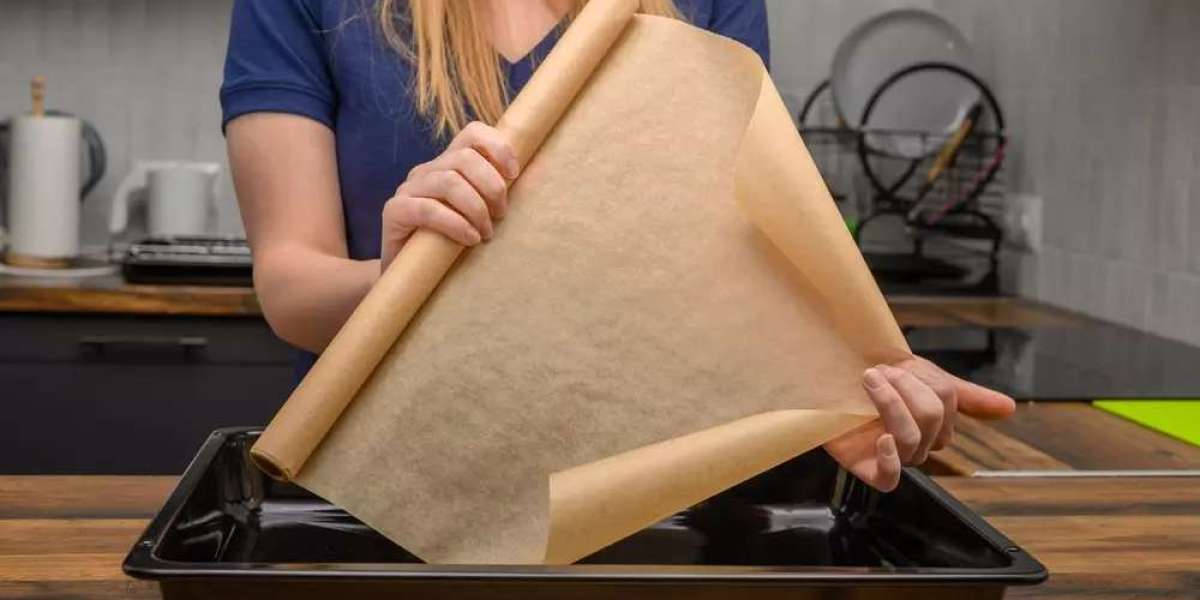

In professional baking and food preparation, the material placed between food and a baking surface can influence handling efficiency, product release, and workflow consistency. Parchment Paper is widely used because its treated surface can provide practical release characteristics while supporting common baking and food preparation processes. For manufacturers, distributors, bakeries, and food-processing businesses, understanding the material structure and production process is useful when selecting paper for different applications.
The production of food paper begins with the base paper. Its fiber structure, surface condition, strength, flexibility, and moisture characteristics can affect later processing. A consistent substrate provides a more stable foundation for coating and converting. If the base material has significant variation, it may become more difficult to maintain consistent surface properties during subsequent production stages.
One of the important processing steps is silicone coating. Silicone is applied to the paper surface to create release characteristics that can help food products separate from the paper after baking or preparation. The coating needs to be distributed evenly across the intended surface. Consistent coverage can support more predictable interaction between the paper and foods containing dough, fats, oils, or moisture.
Coating technology also needs to account for the relationship between the paper substrate and the treated surface. The coating should remain sufficiently attached to the substrate while maintaining the functional characteristics required for the intended application. Production controls can include monitoring coating conditions, checking surface appearance, and inspecting finished material to identify irregularities before conversion and packaging.
Different users may require different formats. Bakeries commonly use pre-cut sheets for trays and preparation areas, while food manufacturers may prefer rolls that can be integrated into their own cutting or wrapping processes. Air fryer liners and other formed paper products require additional downstream processing. This makes converting capability an important part of the overall manufacturing system.
Slitting and cutting influence the usability of finished paper. Accurate converting helps maintain consistent widths, lengths, and edges, which can make the material easier to handle during manual preparation or automated production. Clean processing is particularly valuable when paper is incorporated into standardized workflows where inconsistent dimensions can interrupt normal operations.
Food-contact applications also require attention to production hygiene and quality management. Paper intended for food preparation should be manufactured, handled, and packaged under appropriate conditions. Buyers should review relevant technical and compliance documentation for the particular product and intended market rather than assuming that one document applies to every application. Regional food-contact requirements can differ, making product-specific verification important.
Storage and transportation are additional considerations. Even a properly manufactured paper product can be affected by unsuitable environmental conditions after production. Moisture, dust, compression, and improper handling may influence the condition of rolls or sheets. Appropriate packaging helps protect the material during logistics and supports better preservation during warehouse storage.
For buyers, material selection should therefore consider the complete production chain rather than focusing on one characteristic. Base paper consistency, coating quality, converting accuracy, packaging, inspection, and documentation can all contribute to the suitability of a paper product for commercial use. Application requirements should also be discussed before production so that the selected format and processing method match the customer's actual workflow.
Manufacturing technology can help improve repeatability, but equipment is only one part of quality management. Stable raw materials, controlled production conditions, regular inspection, trained personnel, equipment maintenance, and traceability work together to support consistent output. This integrated approach is especially relevant for businesses that purchase food paper repeatedly and need predictable results between orders.
For international buyers, communication with the production side can also simplify customization. Depending on the application, businesses may need different roll widths, sheet formats, packaging arrangements, or downstream processing. A factory with coating and converting capabilities can discuss these requirements within the context of its production process, helping buyers evaluate whether the material and format are suitable.
Guanghe produces silicone-coated food paper and related food wrapping materials for baking and food preparation applications, with processes covering coating, slitting, cutting, inspection, and packaging. Businesses looking for suitable food paper formats can review the available solutions at https://www.guanghepaper.com/product/ and evaluate the options according to their specific application requirements.