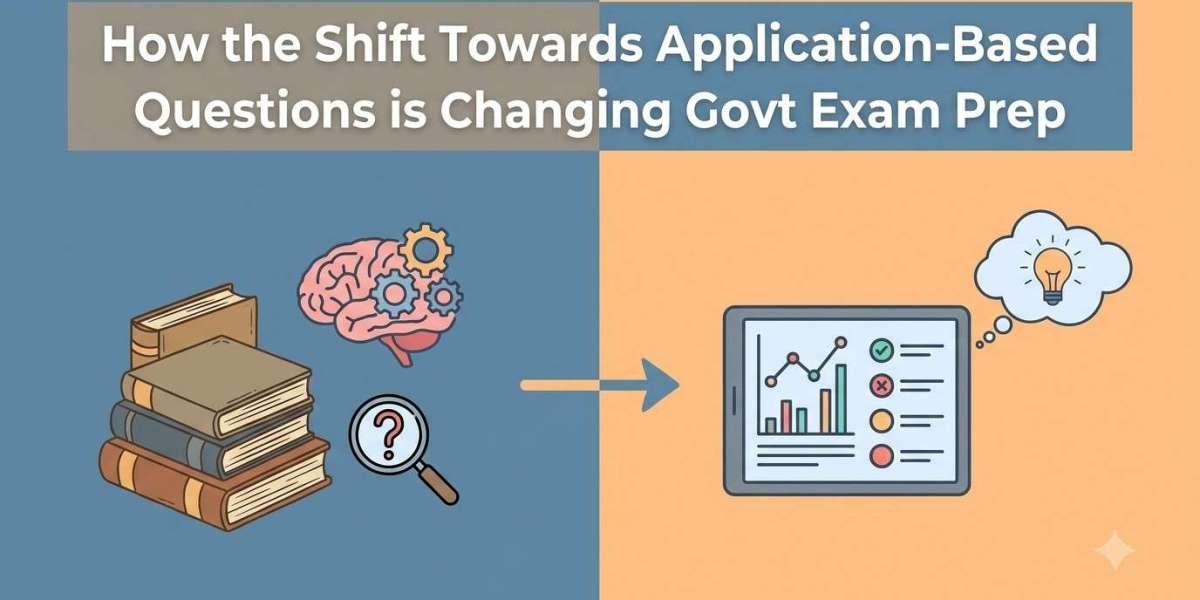

In 2026, the preparation pattern for competitive government exams will change. Before that, a lot of candidates used to prepare by mugging up information, formulas and other stuff and solving similar questions. Now, candidates need to develop an understanding of the concept and solving of the problems along with interpretation and applications. This is even more relevant in the case of candidates who are preparing for Sarkari Naukri through examinations like SSC CGL, UPSC Civil Services Exam and other competitive recruitment examinations.
Going through the official examination syllabus and other preparation materials available currently reveals a trend where candidates are expected to gain an understanding of concepts and solve various types of questions. For example, the SSC CGL 2026 notification mentions that the Quantitative Aptitude test will evaluate an understanding of the appropriate use of numbers and a sense of numbers pertaining to areas that include: percentages; ratio; average; profit and loss; algebra; geometry; trigonometry and data interpretation.
What Are Application-Based Questions?
Questions that focus on applications expect candidates to apply their knowledge in a specific context. The question may not even ask about the definition or formula of a certain concept. Rather, it will give relevant information, conditions, figures or a real-life situation in which the candidate is expected to apply the appropriate concept.
For instance, rather than just stating the formula for calculating profit percentage, the examination may provide the cost price, discount, and selling price and ask candidates to determine the final profit.
Likewise, a reasoning problem may present an unusual situation requiring the application of rules of logic by candidates. This means that having knowledge of the concept is no longer sufficient.
UPSC Shows the Importance of Analytical Preparation
It is quite apparent from the UPSC examination environment. The UPSC Civil Services Preliminary Examination 2026 took place on 24 May 2026, and the Commission has made General Studies Paper I and Paper II question papers available through their official website.
Recent analysis on the UPSC examination has also shown a trend in which the pattern of question has changed from mere facts-based questions to analytical questions. It has been reported by an article in The Indian Express that both the candidates and experts felt that there was a lot of analysis and unpredictability involved in the Civil Services Examination.
It means that for candidates, book reading is necessary; however, just completing books is not enough anymore.
SSC Preparation Is Also Becoming More Concept-Focused
SSC examination questions will always have core subjects such as Quantitative Aptitude, General Intelligence and Reasoning, English and General Awareness. As per the 2026 SSC CGL notice, Quantitative Aptitude entails extensive coverage of arithmetic, algebra, geometry, trigonometry and information-related topics. Also, the notice mentions that English Comprehension is a subject in which the aspirants need to demonstrate their comprehension skills.
Preparation of the subject becomes all the more necessary due to the above factors. The present day preparation tips also emphasize application-oriented topics like geometry. The preparation tips also encourage practice instead of shortcuts.
Shortcuts do help one to save time, but only if the candidate knows the method behind the shortcut. Shortcuts become very risky for those who simply memorize them without knowing where to use them.
Why Rote Learning Alone Is No Longer Enough
The process of memorising is essential for Sarkari Naukri examinations. The candidates have to memorise some important facts, vocabulary, formulae, constitutional provisions, history, geography and current affairs.
It is at the stage when memorising itself constitutes the whole preparation that the difficulty lies. Application-type questions will usually introduce the concept to you in an entirely different way. If a candidate has memorised a formula, he will face a difficulty if he needs to use two concepts together. Similarly, if the candidate has memorised the headlines of current affairs, then he will face difficulty answering what the implications of a certain incident were.
The best way is hence to:
Learn → Understand → Apply → Practice → Analyze → Revise
Mock Tests Are Becoming More Valuable
Mock tests are no longer valuable only for score evaluation purposes. They must be regarded as instruments for measuring application ability.
When a candidate is done with a mock test, they have to look at all the wrong answers, find out why they got the answers wrong. Were they confused with the concept? Did they misunderstand the question? Was the calculation wrong? Had they used the wrong technique or method? Or were they slow?
This will make it easier to detect areas which normal reading alone cannot detect.
The other thing is that candidates must also practice topic-mixed questions. Solving 10 questions all with the same pattern might build confidence, but mixed questions more accurately reflect the situation in a real exam.
Previous-Year Papers Should Become a Core Resource
Previous year's question papers serve as one of the most effective sources for analyzing how the examination makes the transition from syllabus content to questions. The official website of UPSC provides previous years' question papers such as the Civil Services Preliminary Papers of 2026 along with other examinations.
Rather than simply verifying answers, aspirants should categorize questions based on their nature – either factual, conceptual, analytical, numerical, eliminative, or application-oriented.
How Aspirants Should Change Their Daily Routine
Modern-day preparation must involve three aspects: learning, application, and analysis.
Upon studying a subject, answer basic questions to ensure comprehension. Next, try answering moderate to difficult questions that alter the pattern or merge topics. Lastly, analyze errors and modify the concept.
Regarding current affairs, aspirants need to move beyond mere memorization. They need to know the context, key words, governmental measures, economic/social consequences, and connection with static subjects, if any.
Final Takeaway
The increased usage of application-oriented questions is not a way of saying that the relevance of factual knowledge has reduced. Rather, factual knowledge is being used as a building block for developing reasoning and problem-solving skills among the candidates.
If one intends to crack a Sarkari Naukri in 2026, then the best thing to do is to gear up for comprehending and not only rote learning. Study the syllabus, understand the concepts, practice from past years’ papers, try to answer application-oriented questions and learn from your mistakes in the mock tests.