
Europe Long-Duration Energy Storage (LDES) Market: Technologies Shaping Grid Flexibility
Europe's electricity landscape is becoming more renewable, decentralized, and dynamic. As solar and wind generation grow, the power system must handle longer periods of imbalance between supply and demand. This challenge is creating an opportunity for long-duration energy storage, which can retain electricity or usable energy for extended periods and deliver it when the grid needs support.
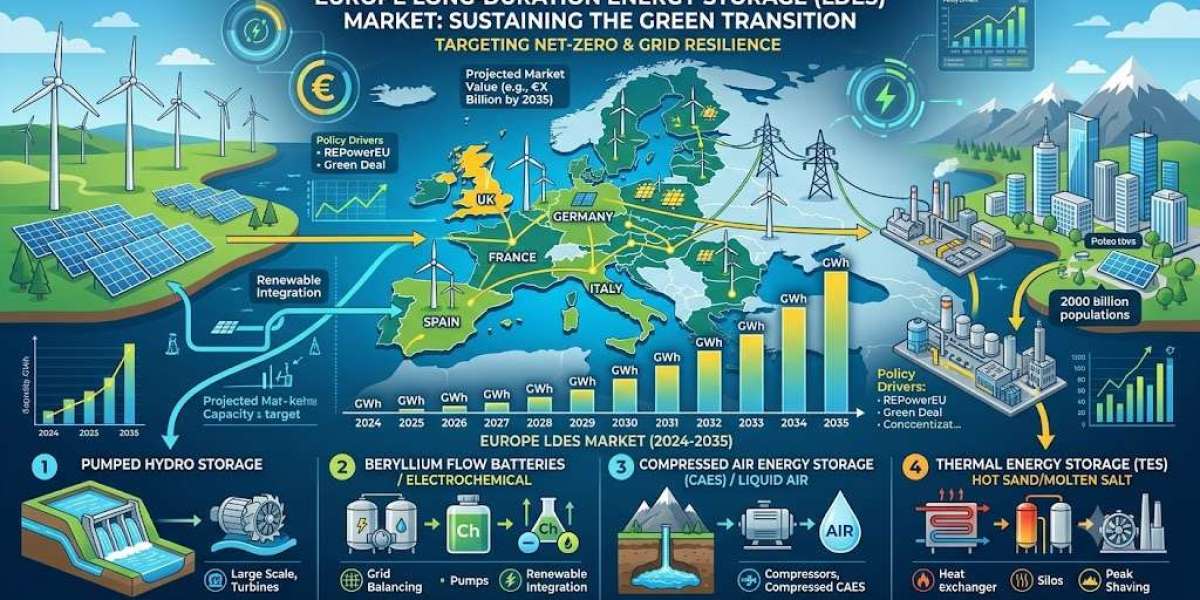
The Europe Long-Duration Energy Storage (LDES) Market includes a broad group of technologies rather than one standardized solution. Pumped hydro, flow batteries, compressed air energy storage, thermal systems, hydrogen-based storage, gravity systems, and several emerging concepts are being evaluated for applications that require longer discharge durations than conventional batteries typically provide.
Pumped hydro remains one of Europe's most established long-duration options. Its ability to store large quantities of energy and provide grid balancing makes it valuable, although geography, permitting, environmental considerations, and construction timelines can limit new development. Existing facilities can therefore become important as renewable penetration rises.
Flow batteries offer another pathway. Their energy capacity can be scaled more independently from power capacity than in many conventional battery designs. This characteristic can support longer discharge periods and frequent cycling. Developers are evaluating flow technologies for renewable integration, grid services, and commercial applications where duration and operational life are important.
Thermal energy storage is gaining attention because electricity does not always have to be stored as electricity. Heat can be stored and later used directly by industrial facilities or converted through appropriate systems. This approach could support sectors with thermal demand while reducing pressure on electricity networks during peak periods.
Compressed air and mechanical storage concepts provide additional diversity. These technologies can potentially support large-scale applications where suitable geological, engineering, or infrastructure conditions exist. Their commercial potential will depend on efficiency, capital costs, site availability, and the value assigned to long-duration services.
Hydrogen also occupies an interesting position in the storage ecosystem. Renewable electricity can be used to produce hydrogen, which can then be stored and consumed later in industrial, mobility, or power applications. While the economics differ from dedicated electricity storage, hydrogen can provide multi-day or seasonal flexibility and connect power markets with other energy sectors.
Technology selection will increasingly depend on application requirements. A storage asset serving frequency response may need fast reaction times and frequent cycling, while a renewable shifting project may prioritize low cost per stored megawatt-hour. Industrial users may value heat output, reliability, and energy cost management. Consequently, comparing technologies only by installed capacity can hide important differences.
A detailed Europe Long-Duration Energy Storage (LDES) Market Analysis considers the interaction between technology, demand, regulation, and deployment economics. These factors are relevant because no single technology is likely to meet every European storage requirement.
Another important consideration is supply chain development. Manufacturing capacity, critical materials, engineering expertise, project finance, and after-sales services can influence the speed at which technologies move from demonstration to deployment. Local supply chains may also become more valuable as Europe seeks greater energy and industrial resilience.
Project developers will need to evaluate duration, efficiency, degradation, land requirements, safety, permitting, and revenue opportunities together. A technically promising system may struggle if it lacks a viable market structure, while a mature technology can remain competitive when project conditions are favorable.
The future of long-duration storage in Europe will therefore be shaped by technology diversity. Instead of replacing short-duration batteries, LDES solutions can complement them, creating layered flexibility across different timescales. As renewable generation and electricity demand continue to evolve, that combination can help Europe build a power system capable of balancing variability while maintaining reliability and affordability.