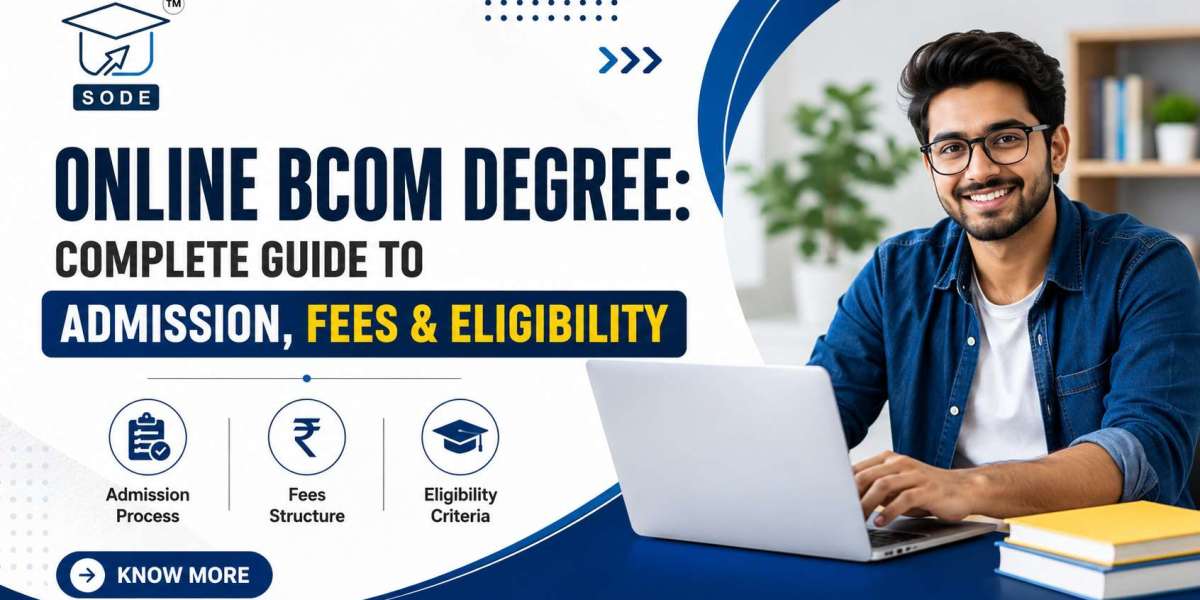

An Online BCom Degree is a flexible undergraduate programme for students who want to study accounting, taxation, finance, banking, economics, and business management without attending daily campus classes. It can be a practical option for Class 12 graduates, working learners, entrepreneurs, and students preparing for professional courses such as CA, CMA, CS, or ACCA.
Before choosing an online BCom course, students should look beyond low fees, discounts, or promotional claims. The university and the specific BCom programme must be approved or entitled for online delivery for the relevant academic session. Students should also compare eligibility, total fees, curriculum, examination method, learning support, and programme duration before applying. Distance Education School helps learners compare universities based on fees, eligibility, recognition, course structure, learning mode, available specializations, and admission requirements.
Overview of the Online BCom Degree
Particular | Details |
Course name | Bachelor of Commerce |
Common abbreviation | Online BCom |
Course level | Undergraduate |
Learning mode | Online Learning |
Standard duration | 3 years divided into 6 semesters |
Basic eligibility | 10+2 or an equivalent qualification from a recognized board |
Eligible streams | Commerce, Arts, or Science, subject to university requirements |
Admission process | Online registration, document verification, and fee payment |
Entrance examination | Usually not required |
Estimated programme fee | Approximately ₹90,000 to ₹1,20,000 for many general programmes |
Major study areas | Accounting, taxation, finance, economics, banking, and business law |
Learning resources | Live classes, recorded lectures, digital material, assignments, and LMS access |
Suitable for | Students, working learners, entrepreneurs, and professional-course aspirants |
Recognition check | Verify the university and programme on the UGC-DEB portal |
What Is an Online BCom Degree?
An Online BCom Degree is a commerce-focused bachelor’s programme delivered through a digital learning platform. Students generally attend live classes, watch recorded lectures, access electronic study material, submit assignments, and receive academic updates through the university’s Learning Management System.
The programme builds foundational knowledge in areas such as:
Financial accounting
Corporate accounting
Business economics
Income tax
Cost accounting
Auditing
Business law
Financial management
Banking and insurance
Marketing
Entrepreneurship
The exact subjects, electives, assessment pattern, and specialization options vary between universities.
Is an Online BCom Degree Valid in India?
An Online BCom Degree can be valid in India when it is awarded by a recognized university that is permitted to offer the programme in online mode.
Students should verify two important points before taking admission:
The university must be legally authorized to award degrees.
The specific Online BCom programme must be approved or entitled for the relevant academic session.
General university recognition does not automatically mean that every course is approved for online delivery. Programme-specific and session-specific verification is necessary.
Students should also confirm that the course is listed under Online Learning rather than only under Open and Distance Learning. Online and distance education are separate modes and should not be treated as interchangeable.
Online BCom Eligibility Criteria
Eligibility conditions differ slightly between universities, but the general requirements are listed below.
Eligibility Requirement | General Condition |
Academic qualification | Passed Class 12, senior secondary, intermediate, or an equivalent examination |
Recognized board | Qualification must be obtained from a recognized national or state board |
Eligible stream | Commerce, Arts, or Science, depending on university policy |
Minimum marks | Usually passing marks or approximately 45%–50% |
Diploma pathway | Some universities may accept a recognized 10+3 diploma |
Age limit | Usually no upper age restriction |
International qualification | An equivalence certificate may be required |
Can Non-Commerce Students Apply for Online BCom?
Many universities allow students from Arts and Science backgrounds to apply for Online BCom programmes. However, applicants should check whether the selected university requires Mathematics, Accountancy, Commerce, or a specific minimum percentage.
Students without a commerce background may initially need additional preparation in bookkeeping, accounting principles, business mathematics, and taxation.
Online BCom Course Duration
The standard duration of an online BCom course is three years, generally divided into six semesters. Each semester includes core commerce subjects, assignments, internal assessments, and examinations.
Some universities may provide an extended completion period under their academic regulations. Students should check the minimum and maximum duration before admission, especially if they plan to study alongside a job or professional qualification.
Online BCom Degree Fees in India
The fee for an Online BCom Degree depends on the university, specialization, learning support, examination system, and whether the programme includes professional certifications.
University or Programme | Total Programme Fee | Semester Fee | Important Note |
Manipal University Jaipur Online BCom | ₹99,000 | ₹16,500 | Total fee covers six semesters |
Amity University Online BCom | ₹99,000 | ₹16,500 | Semester-wise payment may be available |
Amrita Online BCom | ₹1,20,000 | Varies | Additional charges may apply |
Amrita Online BCom with ACCA | ₹2,43,000 | Varies | Higher fee due to professional qualification integration |
These fees are representative and may change. Universities can revise tuition fees, scholarships, examination charges, registration costs, and EMI conditions.
Students should compare the complete payable amount instead of selecting a programme only on the basis of an advertised monthly or semester fee.
Additional Charges to Check
Before paying the admission fee, confirm whether the following are included:
Application or registration fee
Examination fee
Re-examination fee
Project or practical charges
Printed study material charges
Convocation fee
Alumni fee
Professional certification fee
EMI or loan processing charges
Online BCom Admission Process
Admission to an Online BCom programme is generally completed through the university’s official portal.
Step 1: Verify the University and Programme
Check whether the university and the specific BCom programme are approved for online delivery during the selected academic session.
Step 2: Create an ABC ID
Students may need an Academic Bank of Credits ID for maintaining digital academic records.
Step 3: Generate a DEB-ID
A valid DEB-ID is required for admission to recognized online and ODL programmes. It is generally created using the learner’s ABC ID.
Step 4: Register on the University Portal
Enter your name, email address, mobile number, state, and selected programme.
Step 5: Complete the Application Form
Provide personal, academic, contact, and identity details. Enter the ABC ID and DEB-ID where required.
Step 6: Upload Documents
Upload clear and readable copies of the required academic and identity documents in the prescribed format.
Step 7: Pay the Applicable Fee
Pay the registration, semester, or programme fee only through the university’s authorized payment gateway.
Step 8: Complete Document Verification
The university verifies the applicant’s academic qualifications and identity documents before confirming admission.
Step 9: Receive Enrolment Confirmation
After approval, students generally receive an enrolment number, LMS credentials, university email access, and academic instructions.
Documents Required for Online BCom Admission
Required Document | Purpose |
Class 10 certificate | Verification of name and date of birth |
Class 12 marksheet | Confirmation of academic eligibility |
Class 12 passing certificate | Proof of senior secondary qualification |
Aadhaar card or valid identity proof | Identity verification |
Passport-size photograph | Application and university records |
Applicant’s signature | Authentication of the application |
ABC ID | Digital academic record management |
DEB-ID | Admission verification for online or ODL programmes |
Category certificate | Required when claiming an applicable benefit |
Equivalence certificate | May be required for foreign or non-standard qualifications |
The exact document list may differ between universities. Applicants should upload genuine, current, and readable documents.
Common Subjects in an Online BCom Degree
Academic Area | Common Subjects |
Accounting | Financial Accounting, Corporate Accounting, Cost Accounting |
Taxation | Income Tax, GST, Tax Planning |
Finance | Financial Management, Banking, Investment Fundamentals |
Business | Business Organisation, Entrepreneurship, Business Environment |
Law | Business Law, Company Law, Corporate Regulations |
Economics | Microeconomics, Macroeconomics, Business Economics |
Management | Principles of Management, Human Resource Management |
Analytics | Business Statistics, Quantitative Techniques |
Professional skills | Business Communication, Computer Applications, Research Methods |
Some universities may also offer electives or specializations in fintech, banking, accounting and taxation, international finance, or professional accounting.
Who Should Choose an Online BCom?
An Online BCom may be suitable for:
Class 12 graduates seeking a flexible commerce degree
Working learners who cannot attend daily college classes
CA, CMA, CS, or ACCA aspirants
Entrepreneurs seeking knowledge of finance and taxation
Students living away from their preferred university
Learners who need access to recorded classes
Professionals planning to enter accounting or financial operations
Online learning still requires regular study, assignment submission, examination preparation, and independent time management. It should not be considered an effortless alternative to regular education.
Career Scope After an Online BCom Degree
Graduates can explore entry-level opportunities in accounting, taxation, banking, insurance, finance, sales, audit support, and business operations.
Career Area | Possible Entry-Level Roles |
Accounting | Accounts Assistant, Junior Accountant, Billing Executive |
Taxation | Tax Assistant, GST Support Executive, Tax Documentation Associate |
Banking | Banking Operations Executive, Relationship Associate |
Finance | Finance Assistant, Credit Processing Executive |
Insurance | Insurance Operations Associate, Claims Support Executive |
Audit | Audit Assistant, Compliance Support Associate |
Business operations | Operations Executive, Back-Office Associate |
Sales and marketing | Sales Coordinator, Business Development Executive |
These are general career pathways and not official placement guarantees. Employment opportunities depend on the learner’s practical skills, internships, certifications, communication ability, and previous work experience.
Skills to Build Alongside Online BCom
Students should develop practical skills alongside the degree to improve their career readiness.
Useful skills include:
Advanced Microsoft Excel
Tally or similar accounting software
GST return fundamentals
Income-tax basics
Financial statement analysis
Business communication
Data interpretation
Power BI
Basic financial analytics
Internship and project experience
Students can also consider professional and postgraduate options such as CA, CMA, CS, ACCA, CFA, MBA, MCom, banking examinations, or government recruitment examinations.
Online BCom vs Distance BCom
Online and distance education follow different learning structures.
Factor | Online BCom | Distance BCom |
Delivery method | Delivered primarily through a digital platform | Delivered through self-learning materials and academic support |
Classes | Live and recorded online sessions may be available | Contact or counselling sessions may be limited |
Study material | Mainly digital | Printed, digital, or both |
Student interaction | LMS, virtual sessions, and online discussions | Study centres, counselling, or digital support |
Recognition category | Online Learning | Open and Distance Learning |
Verification requirement | Check online programme entitlement | Check ODL programme recognition |
Students should not assume that approval for a distance BCom automatically covers an Online BCom programme.
How Distance Education School Can Help Students
Distance Education School helps learners compare universities based on fees, eligibility, recognition, course structure, learning mode, available specializations, and admission requirements.
It can support students during the university selection and counselling process. However, applicants should independently verify the final programme status and complete fee payments only through authorized university channels.
Important Points Before Taking Admission
Verify the university and programme for the current academic session.
Confirm that the BCom programme is listed under Online Learning.
Check the minimum and maximum course duration.
Compare the complete programme fee and additional charges.
Review the curriculum and available electives.
Understand the examination and assessment method.
Check assignment, attendance, and passing requirements.
Create the required ABC ID and DEB-ID.
Avoid unauthorized agents and unofficial payment links.
Keep copies of the application form and payment receipt.
Conclusion
An Online BCom Degree can provide a flexible and structured foundation in accounting, taxation, finance, banking, and business management. It is suitable for students and working learners who need an alternative to daily campus attendance.
Before taking admission, students should verify the programme’s recognition, eligibility, curriculum, total fees, examination system, and learning support. Choosing the right Online BCom programme requires careful comparison rather than relying only on advertisements, rankings, or low-fee claims.