
An ammunition storage facility in central India runs a routine risk audit and finds its perimeter administrative block still fitted with standard toughened glass. The threat assessment had changed over the years — storage volumes increased, nearby construction shifted blast contours — but the glazing spec never got revisited.
That gap is more common than most facility managers admit. Glazing is often the last item reviewed during a security upgrade, even though it's typically the weakest point in a blast envelope.
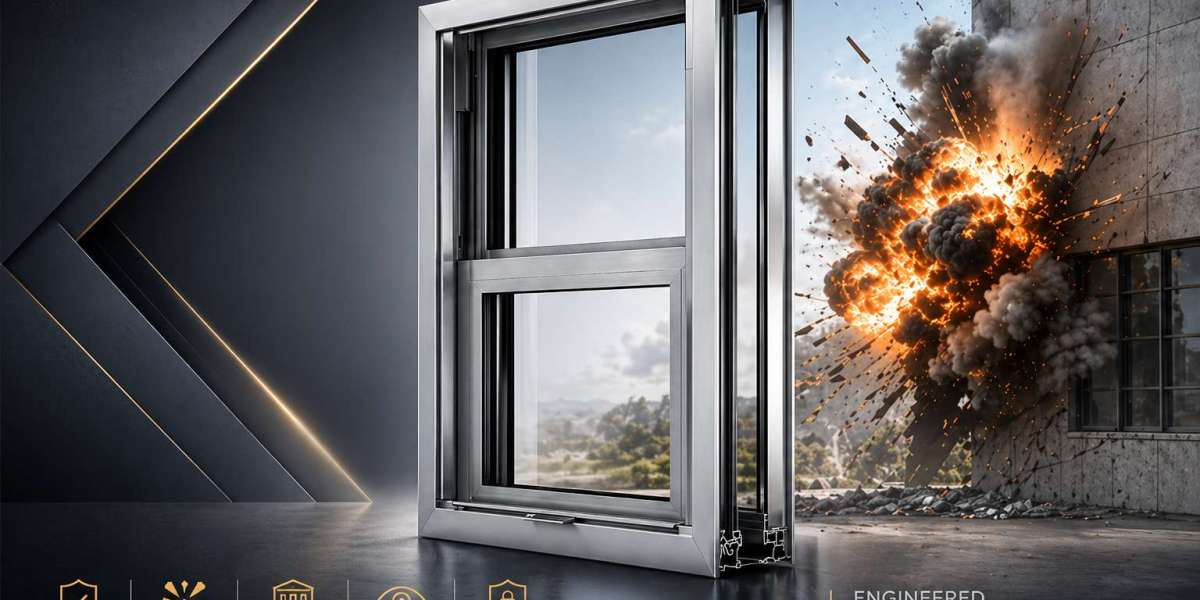
This is where the blast window for home and industrial use case converges: whether it's a residence near a sensitive installation or a control room inside a chemical plant, the engineering requirement is the same — absorb the pressure wave, retain the fragments, keep the opening intact.
How Blast Resistant Glazing Actually Works
A blast wave doesn't hit a window like a bullet. It arrives as a rapid pressure differential that loads the entire glass surface almost simultaneously, then reflects and reverberates for a fraction of a second longer.
Blast resistant glass is engineered around this loading pattern — multiple glass plies laminated with a flexible interlayer designed to stretch rather than shatter into free fragments. The glass is allowed to fail; the interlayer and frame are what prevent it from becoming a projectile.
Frame anchoring matters just as much as the glazing. A blast-rated pane in a standard frame can still fail at the perimeter, defeating the entire system.
Blast Window Design Principles
Good blast window design starts with a defined threat: charge weight, standoff distance, and building use category. From there, engineers select glazing thickness, interlayer type, and frame profile to match a specific blast curve — not a generic "high security" label.
Design also accounts for post-blast behaviour. Codes like ISC/GSA and UK Centre for the Protection of National Infrastructure guidance expect the system to remain serviceable enough to evacuate occupants safely, not just survive the initial event.
Manufacturers Working in the Indian Market
India's blast glazing market includes both dedicated glass technology firms and integrated blast-protection contractors. Vetrotech India supplies laminated glazing under its VETROGARD line, tested to European EN 13541 blast classifications, largely serving banking and government security upgrades.
FG Glass offers its BLASTSHIELD range, combining blast resistance with fire and ballistic performance in configurations tested to GSA standards — useful where a facility needs more than one protective function from a single glazing unit.
On the systems-integration side, Sigmapowertech works on complete blast protection packages spanning both residential and industrial requirements, including Blast window for home installations engineered around site-specific threat assessments rather than off-the-shelf ratings.
Contractors such as Airef Engineers, Envirotech Systems, and Radiant Fire Protection Engineers cover blast door and window packages for petrochemical and defence clients, often bundling structural integration work alongside the glazing supply.
Regional fabricators like Suniti Constructions and Shiv Shakti Fabricators serve mid-sized industrial projects where turnaround time matters as much as certification depth. Always confirm current test documentation directly with any shortlisted supplier — certifications and product lines change year to year.
Key Performance Features
Verified blast resistance against a stated charge and standoff, not a marketing claim
Fragment retention through interlayer bonding strength
Structural reinforcement at the frame-to-wall interface
Corrosion and weather resistance for long-term outdoor exposure
Energy efficiency maintained despite added glazing mass
Low maintenance hardware suited to variable Indian climates
Where This Technology Is Deployed
Typical applications include military facilities, ammunition depots, oil and gas plants, petrochemical units, power generation sites, government buildings, data centres, and industrial control rooms. Residential demand for blast proof windows has also grown near high-risk zones and VIP residences, where discretion matters as much as protection.
What Drives Project Cost
Blast window price depends on blast rating, glazing thickness, frame complexity, and how deeply the system integrates with surrounding structure. A facility-specific risk assessment should set the specification — not a standard product catalogue. Compliance testing and manufacturing precision add upfront cost but reduce long-term liability exposure significantly.
Choosing Among Blast Resistant Window Manufacturers
When evaluating blast resistant window manufacturers, prioritise documented blast engineering experience over glazing production volume alone. Ask for independent test certification matched to your specific rating requirement, not a generic compliance statement.
Confirm customisation capability for non-standard openings, installation support, and a clear post-installation maintenance schedule. Manufacturers offering only the glass — without frame and anchoring expertise — leave a critical gap in the system.
Mistakes That Undermine Blast Protection
Selecting the best blast window on unit price alone, without a site-specific blast-load calculation, is the most common and costly error. Others include pairing tested glazing with an untested frame, skipping compliance verification, and ignoring how the facility's risk profile might change over the asset's lifespan.
Conclusion
Choosing the right blast window for home or industrial application isn't about finding the highest-rated product on a spec sheet — it's about matching engineering to an accurately defined threat, then verifying that every component of the system, from glass to frame to anchor, has been tested together.
Facilities that treat this as structural engineering, not interior finishing, protect both occupants and assets well beyond the initial installation. In blast protection, precision at the specification stage is what determines resilience when it matters most.