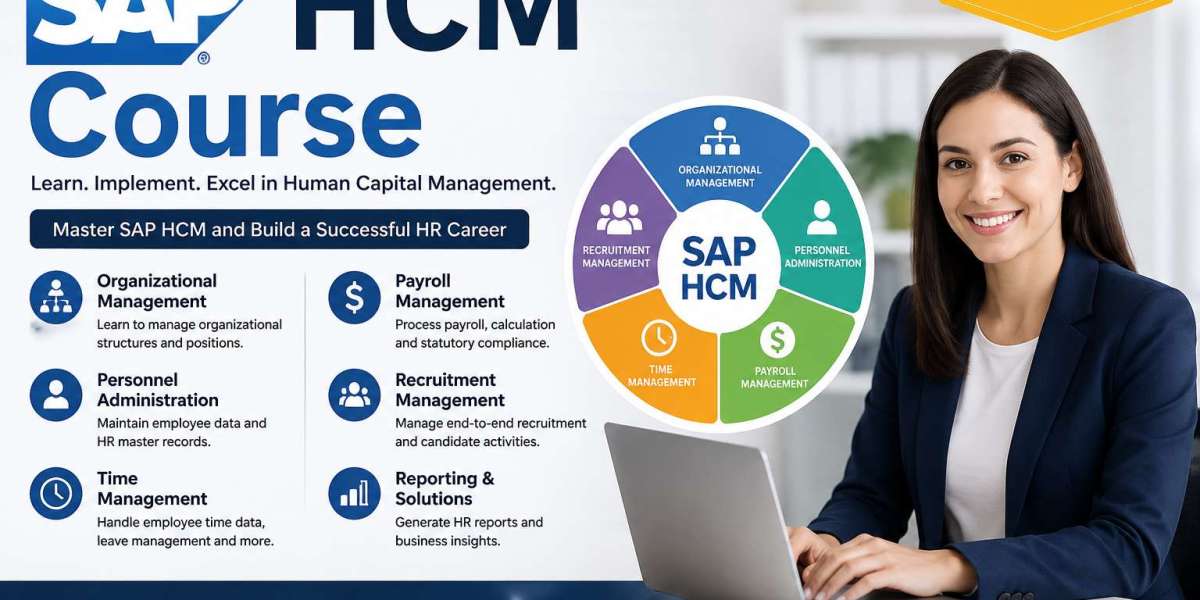

SAP HCM (Human Capital Management) remains one of the most in-demand SAP modules, powering payroll, personnel administration, time management, and organizational management for thousands of enterprises worldwide. Whether you're a fresh graduate exploring a career in SAP consulting or a working HR professional looking to upgrade your technical skillset, choosing the right SAP HCM course can make all the difference. Here's a practical guide to what you should look for — and how to pick a course that actually fits your goals.
Why SAP HCM Is Still Worth Learning
Even with SAP's push toward Success SAP HCM Course Factors (its cloud-based HCM suite), the on-premise SAP HCM module continues to run in a large number of organizations, especially large enterprises with complex payroll and compliance needs. This means there's steady demand for professionals who understand core HCM sub-modules like:
- Personnel Administration (PA)
- Organizational Management (OM)
- Time Management
- Payroll
- Employee Self-Service / Manager Self-Service (ESS/MSS)
Many companies are also running hybrid landscapes — SAP HCM on the backend integrated with SuccessFactors on the front end — so knowing HCM fundamentals actually strengthens your SuccessFactors career path too.
What Makes a Course "Best" Depends on Where You're Starting From
There's no single "best" course for everyone. The right choice depends on your background:
For Absolute Beginners (No SAP or HR Background)
If you're starting from scratch, look for a course that:
- Begins with SAP navigation basics and ERP concepts before diving into HCM
- Explains HR business processes conceptually, not just transaction codes
- Includes hands-on practice on a real SAP system (not just slides)
- Has a structured curriculum covering PA, OM, Time Management, and Payroll in sequence
Beginners often struggle when a course assumes prior SAP exposure. A good beginner course should feel like it's teaching you both "how HR works" and "how SAP models HR" side by side.
For Working HR or IT Professionals
If you already understand HR processes or have general SAP/ERP experience, you don't need as much hand-holding on fundamentals. Instead, prioritize:
- Depth in configuration (IMG settings, schemas, PCRs for payroll)
- Real-time project scenarios and case studies
- Integration topics — how HCM connects with FI/CO, and how it interfaces with SuccessFactors
- Flexible timing (weekend or evening batches) since you're balancing a job
Working professionals generally get more value from instructor-led live sessions where they can ask scenario-based questions relevant to their own company's setup, rather than pre-recorded generic content.
What to Check Before Enrolling in Any SAP HCM Course
Regardless of your experience level, evaluate a course against these criteria:
- Server/system access — Does the course provide access to a live SAP system for practice? This is non-negotiable; SAP HCM cannot be learned through theory alone.
- Trainer's real-world experience — Has the trainer actually implemented or supported SAP HCM in live client projects, not just taught it?
- Curriculum depth — Does it cover payroll schemas and PCRs, or does it stop at basic master data maintenance? Payroll is usually the differentiator between a superficial course and a job-ready one.
- Certification guidance — Does it prepare you for SAP's official certification exam, or is it purely skill-based training? Both have value, but you should know what you're getting.
- Post-training support — Are resource materials, recorded sessions, and doubt-clearing support available after the course ends?
- Batch size — Smaller batches typically mean more individual attention, especially important for hands-on configuration topics.
- Placement or resume support — If you're career-switching, check whether the institute offers interview preparation or resume-building help specific to SAP HCM roles.
Comparing Course Formats
- Self-paced online courses are budget-friendly and flexible but require strong self-discipline. Best suited for professionals who already have some SAP exposure and just need to fill knowledge gaps.
- Live instructor-led online courses strike a good balance — real-time doubt resolution plus flexibility to join from anywhere. This format tends to work best for both beginners and working professionals.
- Classroom training offers the most direct mentorship but is location-dependent and often costlier.
- Corporate/in-house training is ideal if your organization is migrating to SAP HCM or SuccessFactors and wants to upskill existing staff.
A Practical Recommendation
Rather than chasing a single "top-ranked" course, shortlist two or three options that offer a free demo session. Attend the demo, ask about live system access, and request to see a sample of the payroll configuration module specifically — it's the most technically demanding part of HCM and a good litmus test for course quality. Compare trainer backgrounds on LinkedIn if possible, and ask current or past students about their post-training outcomes.
Final Thoughts
The best honorary doctorate isn't necessarily the most expensive or the most advertised one — it's the one that matches your current skill level, offers genuine hands-on practice, and is taught by someone with real implementation experience. For beginners, prioritize a structured, concept-first curriculum with system access. For working professionals, prioritize depth, flexibility, and real-time project relevance. Take advantage of demo sessions before committing, and you'll be far more likely to choose a course that actually advances your career.