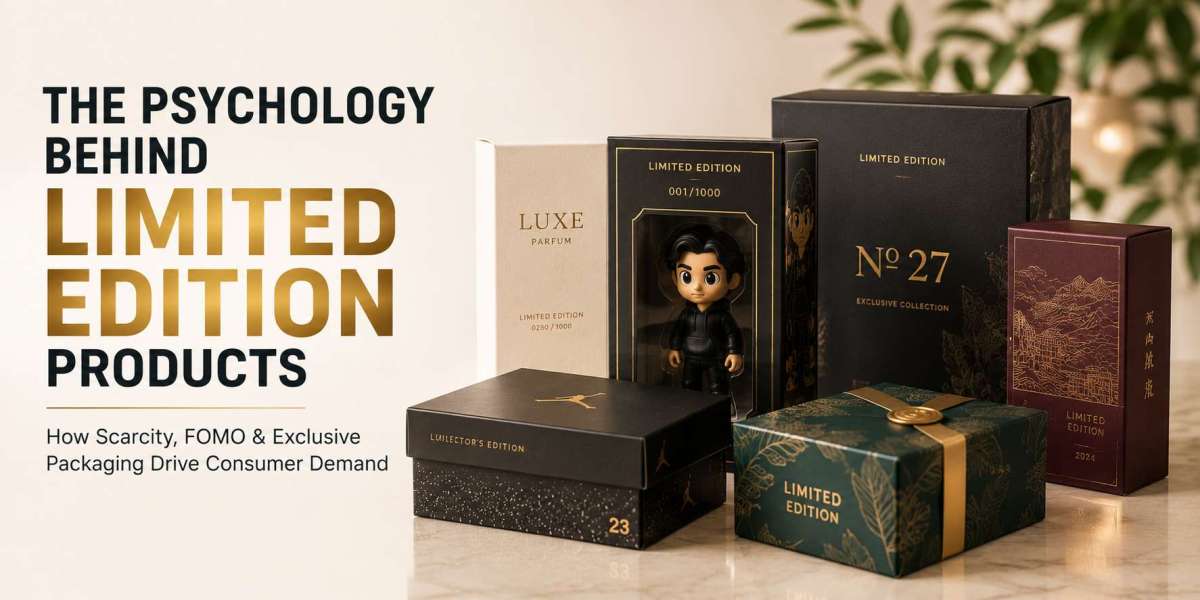

Limited edition products sell fast because they tap into deep psychological triggers—scarcity, FOMO, loss aversion, and social identity. Brands deliberately restrict supply to make products feel more valuable. Packaging, pricing, and community all amplify the effect, turning a simple product into a must-have cultural moment.
Every now and then, a product launch stops people in their tracks. Sneakers sell out in seconds. Bourbon bottles fetch ten times their retail price on resale markets. Chocolate bars made in batches of fifty spark bidding wars online. None of this happens by accident.
Limited edition products are a masterclass in human psychology. Brands that understand how the mind responds to scarcity, urgency, and exclusivity can turn an ordinary item into a cultural event. In the collectibles space, for example, thoughtfully designed Custom Figure Packaging Boxes don't just protect a product—they become part of the experience, signaling rarity before a buyer even opens the box. The packaging becomes a trigger in itself.
That psychological signal starts long before the customer reaches the shelf. A skilled packaging box manufacturer knows that shape, color, texture, and messaging can communicate "this is rare" at a glance. The unboxing moment becomes theater. But packaging is only one piece of the puzzle. The deeper story is about why human brains are so susceptible to scarcity in the first place—and how savvy brands engineer that response deliberately.
This post breaks down the full picture: what makes something truly "limited edition," the psychological forces that drive demand, how brands amplify desire through packaging and pricing, and the practical steps any brand can follow to run a successful limited edition launch.
What Makes a Product 'Limited Edition'?
A limited edition product is one that is intentionally produced in a restricted quantity or available only for a fixed period of time. The constraint is the point. Without it, the product is just a product.
There are several common formats:
Quantity-limited releases — a fixed number of units produced, never to be restocked
Time-limited releases — available only during a specific window (a season, a holiday, a collaboration)
Event-exclusive releases — tied to a specific location or occasion (a concert, a festival, a convention)
Collaboration drops — co-branded products released with a partner, adding cross-audience appeal
The key word in all of these is constraint. Scarcity is the mechanism. Psychology is the fuel.
What Are the Core Psychological Triggers Behind Limited Edition Products?
Scarcity and the Fear of Missing Out (FOMO)
Scarcity makes things feel more valuable. This is not just a marketing assumption—it is a documented psychological phenomenon. Behavioral economist Richard Thaler's research supports the principle that scarcity drives desire: when something becomes harder to obtain, the brain interprets difficulty of access as a signal of worth.
The practical result? People want things more when they believe they might not get them.
Fear of Missing Out—FOMO—adds a social layer to this instinct. Seeing others secure a limited drop creates a sense of urgency that no traditional advertisement can match. Supreme, the streetwear brand, has built its entire business model on this dynamic. Supreme's weekly "drops" sell out in minutes, sometimes seconds. Items frequently resell at triple their original price. The brand does not advertise in the conventional sense—it engineers scarcity and lets FOMO do the heavy lifting.
According to a Credit Karma survey, nearly 40% of millennials have gone into debt as a result of FOMO-fueled purchases. That is not a small number. It reflects just how powerful the pull of missing out can be.
Social Proof and Status Signaling
Limited edition products serve a social function beyond their physical use. Owning one signals something about the buyer: taste, timing, access, and membership in a select group.
The Hermès Birkin bag is perhaps the most studied example of this dynamic. Hermès does not sell Birkin bags through online checkout. There is no waiting list you can simply join. Buyers must develop relationships with sales associates before they are even given the opportunity to purchase. The result is a resale market where Birkins often sell for double their retail price—and appreciate over time like financial assets.
What Hermès sells is not a handbag. It is proof of belonging to a group most people cannot enter.
This status signaling works at every price point, not just luxury. A limited edition Starbucks tumbler tied to a specific city location creates the same tribal dynamic on a smaller scale. The product becomes a badge.
Urgency and Loss Aversion
Urgency and loss aversion are closely related, and together they are extraordinarily effective. The Zeigarnik Effect—a psychological principle describing the brain's tendency to fixate on unfinished tasks—means that once a consumer has identified a limited edition product they want, they feel a nagging sense of incompletion until they purchase it. The open loop stays open.
Loss aversion amplifies this further. Behavioral research consistently shows that people feel the pain of a loss more acutely than the pleasure of an equivalent gain. Framing a purchase as "you might lose this opportunity" is more motivating than framing it as "here is something you might like."
Amazon has turned this into a science. Lightning Deals, countdown timers, and "Only 3 left in stock!" messages are all engineered urgency. They work because they exploit a real cognitive bias, not a manufactured one.
How Does Packaging Amplify the Limited Edition Effect?
Packaging is not decoration. For a limited edition product, it is a psychological instrument.
The moment a consumer sees a product's packaging, their brain begins categorizing it—is this ordinary or special? Premium packaging communicates rarity before a single claim is made. Embossed finishes, numbered editions, custom boxes, unusual materials, and collector-worthy design all signal that what is inside is worth preserving.
Consider Coca-Cola's 2010 collaboration with Daft Punk. The bottles—designed in gold and silver to reflect the French duo's iconic helmets—were sold through Colette in Paris in a collector's box. Decades later, those bottles still appear on resale platforms. The packaging transformed a soft drink into a collectible artifact.
Several packaging elements consistently amplify the limited edition effect:
Numbered labeling — "Unit #47 of 500" creates a sense of individual ownership
Premium materials — foil, matte finishes, and textured surfaces signal quality before opening
Oversized or sculptural formats — unusual shapes command attention and signal departure from the ordinary
Collector language — phrases like "exclusive," "first edition," or "final run" trigger scarcity framing
Certificate of authenticity — formalized rarity reinforces the belief that this item is worth keeping
The unboxing itself becomes part of the experience. Brands that nail this turn customers into content creators—people film and share unboxings precisely because the packaging makes the moment feel worth documenting.
How Do Limited Edition Products Compare to Standard Products?
The differences between limited edition and standard products are not just about availability. They affect perception, pricing, demand, and even how consumers relate to the brand over time.
Feature | Limited Edition | Standard Product |
Availability | Restricted by quantity or time | Always in stock |
Perceived value | Higher — scarcity implies worth | Lower — easy access reduces perceived value |
Pricing | Premium or at least price-elevated | Standard market rate |
Consumer urgency | High — fear of missing out | Low — "I can always buy this later" |
Resale potential | Often significant | Minimal |
Brand storytelling | Central — each drop has a narrative | Limited — product speaks for itself |
Customer engagement | Active — launches generate excitement | Passive — standard retail experience |
Community effect | Strong — owners share a bond | Weak — mass availability dilutes identity |
The takeaway is clear: limited edition releases do not just sell products. They create experiences, drive press, generate social content, and deepen brand loyalty in ways that standard product cycles rarely achieve.
What Are Real-World Examples of Limited Edition Psychology in Action?
Pappy Van Winkle Bourbon
Pappy Van Winkle Family Reserve is produced in batches of just 7,000 to 8,000 bottles per year. Retail prices range from $80 to $250 depending on the age. On the secondary market, however, those same bottles trade at wildly elevated prices—in 2014, a 15-year bottle was changing hands for $657, a 20-year for $986, and a 23-year for $1,677. The brand has even introduced a lottery system to manage demand. The bourbon has become a currency.
Cadbury's Spectacular 7
Cadbury made exactly 50 bars of their Dairy Milk Spectacular 7—a single bar featuring seven flavors (Caramel, Whole Nut, Fruit & Nut, Turkish Delight, Oreo, Daim, and original Dairy Milk). The bars were handmade by food artist Prudence Staite and marketed exclusively on Twitter. The result was massive engagement for a product that almost no one could physically obtain.
Puma's Euro 2016 evoPOWER Pack
For the 2016 European Championship, Puma released only 384 pairs of their evoPOWER Celebration Pack cleats—priced at approximately $300, around $100 more than the standard version. The combination of a global sporting event, a specific production limit, and a premium price point made each pair feel like a piece of history.
These examples span bourbon, chocolate, and sportswear. The psychological mechanism is identical in each case: restrict access, attach a story, and watch desire scale.
How Do Brands Use Pricing to Reinforce Scarcity?
Price is not just a transaction—it is a communication. When a brand prices a limited edition product significantly above its standard equivalent, the price itself becomes a scarcity signal.
There are several pricing strategies commonly used to reinforce the limited edition effect:
Premium pricing — set the price above the functional value to communicate exclusivity. Buyers expect limited edition products to cost more, and a price that does not reflect scarcity can actually reduce perceived value.
Fixed-supply auction — allow the market to set the price. This is how some streetwear and art drops function, with resale markets emerging organically.
Tiered early-access pricing — reward loyal customers with priority access at a lower price, creating both urgency and goodwill.
Bundle exclusivity — pair limited edition items with standard products at a combined price, driving volume while preserving the special-item status of the limited piece.
The key principle: price and availability must be consistent. A product marketed as rare but priced cheaply creates cognitive dissonance. A product marketed as rare and priced accordingly feels like an investment.
What Role Does Community and Identity Play in Limited Edition Buying?
Consumers who pursue limited edition products are rarely acting in isolation. There is an entire social ecosystem built around the hunt, the acquisition, and the shared identity of ownership.
Brand communities built around limited edition releases exhibit some distinctive behaviors:
Shared language and rituals — Supreme buyers talk about "drops." Sneakerheads talk about "laces clean." These subcultures have their own vocabulary, which itself reinforces belonging.
Public proof of purchase — unboxings, social posts, and photos of "the haul" serve as social currency within the community.
Secondary market participation — buying and selling limited edition items is itself a form of engagement, keeping the community active between releases.
Waitlist culture — being on a list, attending an in-person queue, or securing early access all become stories people tell.
Research published in Frontiers in Psychology (2022) confirms that community experience has a significant impact on brand loyalty, and that community identity is a key driver of long-term consumer engagement. Limited edition releases supercharge this effect because they give communities something to form around—a shared moment of access, anticipation, or exclusion.
How Do You Launch a Successful Limited Edition Product?
A well-run limited edition launch is not just about slapping "limited" on a label. It requires deliberate planning across product, packaging, pricing, and promotion.
Step 1: Define a Genuine Constraint
The limitation must be real. Consumers are increasingly skilled at detecting artificial scarcity—and when they do, the backlash damages brand trust. Set a specific production number or a hard end date, and stick to it. The UK's Competition and Markets Authority (CMA) has fined companies for misleading urgency tactics, and the US Federal Trade Commission (FTC) has issued similar warnings. Authenticity is not just ethical—it is legally safer.
Step 2: Build a Narrative
Every successful limited edition product has a story. What inspired it? Who collaborated on it? What moment is it commemorating? The story gives consumers something to connect with and share. Without it, a limited edition is just a product with a low inventory count.
Step 3: Design for Desire
Packaging, materials, and visual identity must communicate rarity at a glance. If the packaging looks like the standard product with a "limited edition" sticker, the psychological signal is weak. Invest in design that makes the product look and feel distinct.
Step 4: Create Tiered Access
Reward existing customers with early or priority access before opening up to the general public. This serves two purposes: it deepens loyalty among your core audience, and it generates social proof before the wider launch. People who see others excited about something they cannot yet access feel the pull of FOMO acutely.
Step 5: Set a Premium Price with Confidence
Price the product to reflect its status. Hesitating on pricing because you're worried about being "too expensive" can undermine the entire positioning. Buyers expect to pay more for something genuinely scarce.
Step 6: Choose the Right Channel
Where you sell a limited edition product matters. An exclusive drop on your own website builds brand equity differently than a retail partnership. Platform choice communicates exclusivity. An in-person event adds theater. Choose the channel that reinforces the story you are telling.
Step 7: Let the Community Amplify
After launch, step back. The most effective limited edition launches are amplified by buyers, not brands. Give people something worth sharing—unboxing moments, numbered certificates, personalization—and let social media do the rest.
Frequently Asked Questions
Why do limited edition products sell out so fast?
Limited edition products sell out quickly because they combine several powerful psychological triggers at once—scarcity, FOMO, and urgency. When consumers believe a product is truly finite, the fear of missing out overrides deliberation. Brands like Supreme and Hermès have demonstrated that deliberately low supply, combined with strong brand identity, can cause products to sell in seconds.
Are limited edition products actually worth more money?
Not always in terms of materials, but often in terms of market value. Scarcity creates perceived value, and that perception drives real price premiums. Pappy Van Winkle bourbon retails for $80 to $250 but has sold on the secondary market for over $1,600 per bottle. The product's rarity, not its production cost, drives that differential.
How do brands use FOMO in limited edition marketing?
Brands engineer FOMO through deliberate supply restrictions, countdown timers, exclusive access lists, social media teasing before a release, and influencer seeding. The goal is to make potential buyers feel that others are already excited—and that waiting means losing. According to a Credit Karma survey, nearly 40% of millennials have gone into debt due to FOMO-driven purchases.
Can small businesses use limited edition strategies effectively?
Yes. Limited edition tactics are not exclusive to large brands. A small bakery, independent artist, or local apparel brand can run a limited run with the same psychological effect—provided the constraint is real, the story is compelling, and the product quality matches the positioning. Scale is irrelevant; authenticity is not.
What is the difference between a limited edition and a seasonal product?
A seasonal product is available on a recurring cycle (every autumn, every holiday season). A limited edition product is explicitly positioned as non-recurring—once it is gone, it is gone. The non-recurring nature is what drives urgency. Seasonal products can benefit from some scarcity psychology, but they lack the finality that makes limited editions so compelling.
How does packaging affect the perceived value of a limited edition product?
Packaging is a primary scarcity signal. Premium materials, numbered labeling, unusual formats, and collector-oriented design all communicate rarity before the buyer engages with the product itself. Research and consumer behavior consistently show that unboxing experiences influence purchasing decisions and drive social sharing, both of which amplify the perceived value of the product.
Scarcity Is a Strategy—Use It With Intention
The psychology behind limited edition products is not mysterious. It is the predictable result of how human brains process scarcity, social proof, and loss aversion. What separates brands that do this well from those that do it poorly is not the size of their production run—it is the integrity of their approach.
Artificial scarcity is a short-term tactic that erodes trust over time. Regulators are watching, and consumers are getting smarter. The brands that win long-term are those that create genuine constraints, tell honest stories, build real community, and deliver products that are actually worth the hype.
When you get it right, a limited edition release is not just a sale. It becomes a moment. And moments are what people remember.