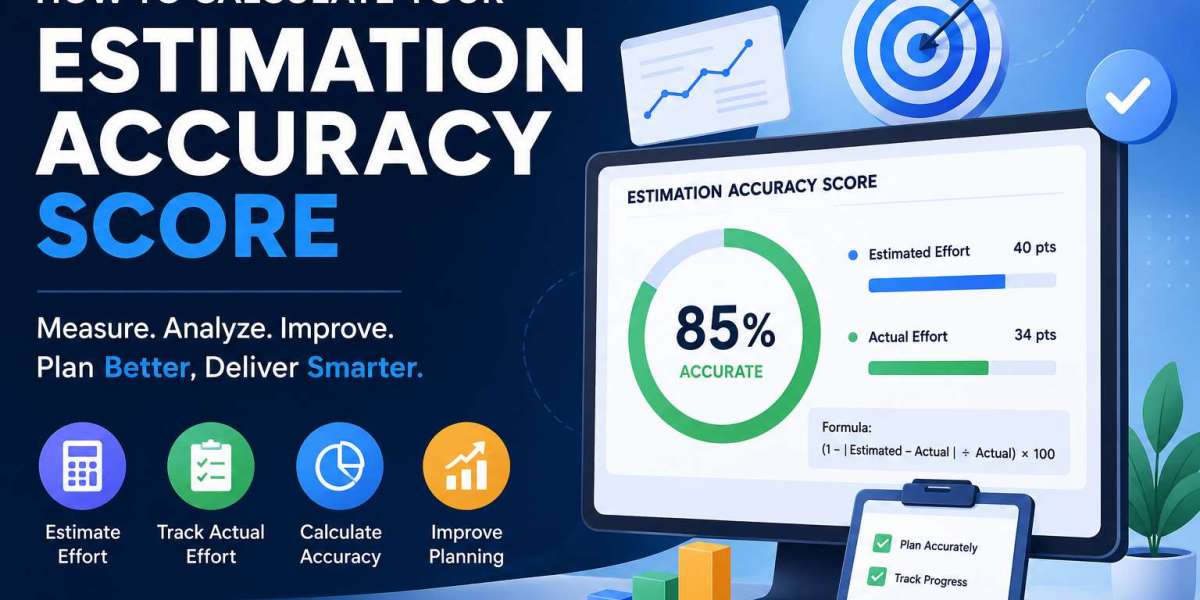

Project estimation plays a critical role in Agile software development. Teams use estimates to plan sprints, allocate resources, and forecast delivery timelines. However, estimates are only valuable if they are reasonably accurate. Measuring estimation quality helps organizations improve planning and deliver projects more predictably.
One of the most effective ways to evaluate planning performance is by calculating the Estimation Accuracy Score. This metric compares estimated effort with actual effort and helps Agile teams continuously refine their estimation process.
What Is an Estimation Accuracy Score?
An Estimation Accuracy Score is a metric that measures how closely an estimated effort matches the actual effort required to complete a task or user story. It provides insight into the reliability of a team's estimation process.
A higher accuracy score indicates that project estimates closely align with real-world outcomes, making sprint planning and release forecasting more dependable.
How Do You Calculate Estimation Accuracy?
A widely accepted formula is:
Estimation Accuracy (%) = (1 − |Estimated Effort − Actual Effort| ÷ Actual Effort) × 100
Example
Estimated Story Points: 15
Actual Story Points: 18
Difference = 3
Estimation Accuracy = (1 − 3 ÷ 18) × 100
= 83.33%
This calculation helps teams objectively evaluate how accurate their estimates were and identify opportunities for improvement.
Also Read Our Blog: What is Cognitive project management
Why Is Estimation Accuracy Important?
Tracking estimation accuracy offers several benefits for Agile teams and project managers:
Improves sprint planning and backlog refinement.
Enables more reliable project forecasting.
Reduces delivery risks and schedule overruns.
Supports continuous process improvement.
Builds stakeholder confidence with realistic timelines.
Helps identify recurring estimation challenges.
Organizations that consistently monitor estimation accuracy often achieve more predictable software delivery and better team performance.
Factors That Affect Estimation Accuracy
Several variables can influence the quality of project estimates:
Incomplete or changing requirements.
Large and complex user stories.
Limited historical project data.
Unexpected technical challenges.
Resource availability.
Communication gaps within the development team.
External dependencies.
Understanding these factors allows teams to make more informed estimates during sprint planning.
Best Practices to Improve Estimation Accuracy
Teams can improve estimation quality by following proven Agile practices:
Break large features into smaller user stories.
Use collaborative estimation techniques such as Planning Poker.
Review historical sprint performance.
Analyze estimation variance after every sprint.
Include technical risks during estimation.
Continuously refine estimation guidelines using retrospective feedback.
Leverage historical data instead of relying solely on intuition.
Small improvements made consistently can significantly increase estimation reliability over time.
How AI Improves Project Estimation
Artificial Intelligence is changing the way Agile teams estimate software projects. Modern estimation platforms analyze historical sprint data, project complexity, delivery trends, and team performance to generate more consistent estimates.
AI-assisted estimation reduces human bias, improves forecasting, and provides project managers with data-driven recommendations that support better planning decisions.
As software development becomes increasingly complex, AI-powered estimation tools are helping organizations achieve higher planning accuracy and more predictable outcomes.
Learn More About Estimation Accuracy
If you want a detailed explanation of estimation accuracy, including the calculation formula, practical examples, and strategies for improving Agile planning, read the complete guide published by Baseliner AI:
How to Calculate Your Estimation Accuracy Score
https://baseliner.ai/blog/how-to-calculate-your-estimation-accuracy-score/
The guide explains the concept in depth and demonstrates how AI-powered estimation can help teams improve sprint planning, forecasting, and delivery confidence.
Frequently Asked Questions
What is an ideal estimation accuracy score?
Most Agile teams aim for high consistency rather than perfection. An accuracy score above 80% generally indicates reliable estimation practices, although acceptable ranges vary depending on project complexity.
Should estimation accuracy be measured every sprint?
Yes. Reviewing estimation accuracy after each sprint helps teams identify trends, improve planning, and refine estimation techniques over time.
Can AI improve estimation accuracy?
Yes. AI-powered estimation tools analyze historical project data and delivery patterns to recommend more realistic estimates and reduce planning errors.
Conclusion
Measuring your Estimation Accuracy Score is one of the most effective ways to improve Agile planning. It provides objective feedback on estimation quality, supports continuous improvement, and helps teams deliver projects with greater confidence.
By combining Agile best practices with AI-powered estimation solutions like Baseliner AI, organizations can create more accurate project plans, reduce uncertainty, and improve software delivery outcomes.