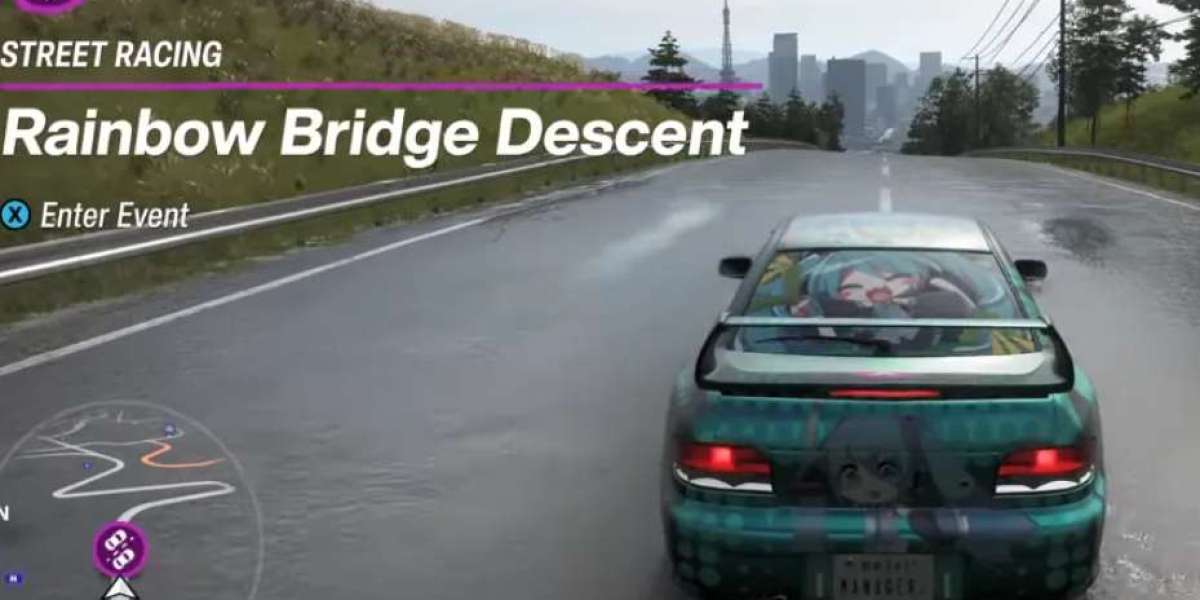

To master the Rainbow Bridge Descent in Forza Horizon 6, you need to handle one of the most demanding mixed-surface events in the game. The challenge isn’t just speed—it’s adapting instantly from tight urban racing in Tokyo City to long, high-speed highway runs across the Rainbow Bridge, all while dealing with low-grip post-rain asphalt and nighttime visibility.
This 5.3-mile Street Race takes place on the northern side of the Nangan Region. The conditions are always fixed: Spring season, cloudy skies after rain, and a nighttime setting. That combination makes grip unpredictable in the city sections and stability crucial on the bridge.
Event Profile
The Rainbow Bridge Descent is structured around two very different racing environments stitched together into a single run.
The race begins in dense Tokyo City streets, where corners are tight, frequent, and mostly 90-degree turns. These sections punish over-driving and reward precision. After the final city exit, the track suddenly opens up into a long, sweeping highway run across the Rainbow Bridge. This is where top speed and clean acceleration decide the outcome.
The transition between these two zones is the core challenge of the event.
Key Mastery Strategies
Tire and Suspension Tuning
Because the surface is wet from recent rain, grip is significantly reduced throughout the entire race. Cars that feel stable on dry asphalt may become unpredictable here.
A softer suspension setup helps maintain consistent tire contact on uneven, slippery roads. Anti-roll bars and damping should be tuned more toward stability than sharp responsiveness. Overly stiff setups tend to lose traction during quick direction changes in the city.
Once you reach the bridge, acceleration and top speed become the priority. A balanced build that doesn’t sacrifice too much stability in exchange for straight-line speed works best.
Nail the City Exit
The most important moment of the race happens before you even reach the bridge.
The final turns in the city determine your entry speed onto the highway. Many players lose the race here by pushing too aggressively and sliding out of corners. Instead, focus on clean racing lines and smooth exits.
A slightly slower but controlled approach through the last urban section usually results in a much faster overall time once you hit the open road.
Drafting and Overtaking
Once you are on the Rainbow Bridge, the race becomes all about positioning and slipstream management.
The bridge provides long straight lanes, which makes drafting extremely powerful. Staying behind another car allows you to build speed efficiently before pulling out to overtake. However, sudden steering inputs at high speed can easily lead to spins, especially on damp asphalt.
Overtaking should be deliberate and smooth. Avoid sharp lane changes at speeds above 150 mph unless you have a clear gap.
Beating Rivals Mode
If you are playing through the “Discover Japan” progression path or tackling Touge & Street Rivals challenges, the Rainbow Bridge Descent often appears as a key event for unlocking rewards such as high-performance Nissan variants.
To successfully complete it in Rivals mode, consistency matters more than raw speed.
No Collisions
Any contact with walls, traffic, or barriers will invalidate a clean attempt. Even minor scrapes can ruin a qualifying run.
No Rewinds
Using rewind will disqualify your clean lap. You need to commit fully to each corner, especially in the city section where mistakes are most likely.
Miss No Checkpoints
The layout includes multiple checkpoint gates, and missing even one will immediately end your run. Precision matters more than aggression.
No Auto-Drive Assists
Make sure all driving assists related to steering or auto-correction are disabled. These systems can interfere with control during high-speed transitions, especially on the bridge.
The Rainbow Bridge Descent is not a pure speed test. It is a transition challenge that rewards drivers who can adapt quickly between technical street racing and high-speed highway driving.
If you stay patient in the city, tune your car for stability in wet conditions, and control your overtakes on the bridge, you will consistently outperform players who rely only on raw speed.