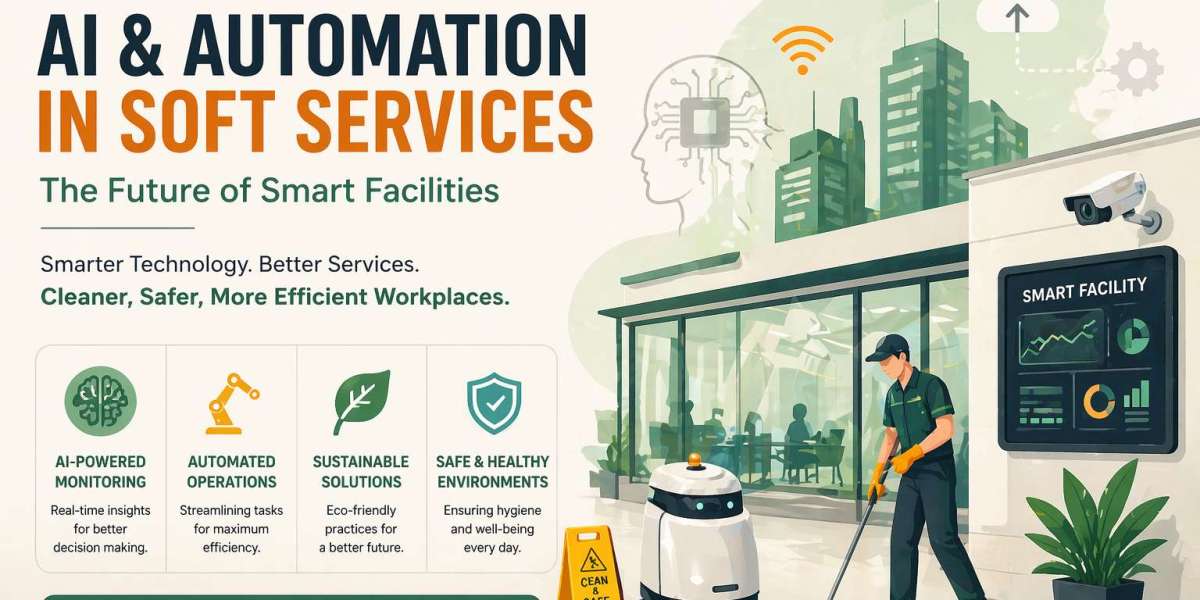

The world of facility management is rapidly transforming, and soft services are no exception. With the rise of artificial intelligence (AI) and automation, businesses are moving toward smarter, more efficient, and highly responsive environments. From automated cleaning systems to AI-powered monitoring, these technologies are redefining how soft services are delivered.
In this blog, we explore how AI and automation in soft services are shaping the future of smart facilities and why businesses must adapt to stay competitive in 2026 and beyond.
What Are Soft Services in Facility Management?
Soft services include essential non-technical services such as cleaning, housekeeping, pest control, waste management, and landscaping. These services ensure that workplaces remain clean, safe, and comfortable for employees and visitors.
With the integration of AI and automation, these services are becoming more efficient, data-driven, and cost-effective.
Why AI and Automation Are Important in Soft Services
Traditional soft services often rely on manual processes, which can be time-consuming and inconsistent. AI and automation bring a new level of precision and reliability by:
- Reducing human errors
- Improving service efficiency
- Enhancing real-time monitoring
- Optimizing resource utilization
These advancements help businesses maintain higher standards of hygiene and service quality.
Key Applications of AI and Automation in Soft Services
1. Smart Cleaning Systems
Robotic vacuum cleaners and automated floor scrubbers are becoming common in offices and commercial spaces. These machines use AI to map spaces and clean efficiently without human intervention.
Benefits include:
- Consistent cleaning quality
- Reduced labor costs
- Time-saving operations
2. IoT-Based Monitoring
Internet of Things (IoT) devices allow facility managers to monitor cleaning schedules, waste levels, and air quality in real time.
This helps in:
- Better decision-making
- Predictive maintenance
- Improved hygiene standards
3. AI-Powered Workforce Management
AI tools help in scheduling staff, tracking performance, and optimizing workloads. This ensures that the right resources are allocated at the right time.
4. Smart Waste Management
Automated waste bins with sensors can detect fill levels and notify staff when they need to be emptied. This reduces unnecessary work and improves efficiency.
5. Predictive Maintenance
AI systems analyze data to predict when maintenance is required. This prevents breakdowns and ensures smooth facility operations.
6. Enhanced Security Integration
AI-powered surveillance systems and access control solutions are being integrated with soft services to deliver comprehensive facility management.
Benefits of AI and Automation in Soft Services
Improved Efficiency
Automation reduces manual effort and speeds up operations, allowing businesses to maintain high standards with fewer resources.
Cost Optimization
AI helps in reducing operational costs by optimizing resource usage and minimizing waste.
Better Hygiene and Safety
Advanced technologies ensure consistent cleaning and monitoring, improving workplace hygiene and safety.
Data-Driven Insights
AI provides valuable data that helps make informed decisions and improve service quality.
Challenges of Implementing AI in Soft Services
While AI and automation offer numerous benefits, businesses may face challenges such as:
- High initial investment
- Need for skilled workforce
- Integration with existing systems
However, the long-term benefits outweigh these challenges.
Future of Smart Facilities
The future of facility management lies in smart, connected environments. AI and automation will continue to evolve, offering more advanced solutions such as:
- Fully autonomous cleaning systems
- AI-driven facility management platforms
- Smart buildings with self-maintenance capabilities
Businesses that adopt these technologies early will gain a competitive advantage.
How Businesses Can Prepare for the Future
To stay ahead, organizations should:
- Invest in modern technologies
- Train staff to work with AI systems
- Partner with professional service providers
- Focus on sustainability and efficiency
F&Qs
1. What is AI in soft services?
AI in soft services uses smart technology to automate cleaning, monitoring, and facility tasks, improving efficiency, accuracy, and service quality.
2. How does automation improve facility management?
Automation reduces manual work, increases efficiency, ensures consistent service delivery, and helps optimize resources in facility management.
3. What are smart facilities?
Smart facilities use AI, IoT, and automation to manage operations, improve efficiency, enhance safety, and provide better user experiences.
4. Is AI expensive for soft services?
AI may have high initial costs, but it reduces long-term expenses by improving efficiency, lowering labor costs, and minimizing waste.
5. What is the future of AI in facility management?
AI will drive smart facilities with automation, predictive maintenance, and real-time monitoring, making operations more efficient and cost-effective.
Conclusion
AI and automation are revolutionizing soft services and paving the way for smarter, more efficient facilities. Businesses that embrace these technologies will benefit from improved productivity, better hygiene standards, and cost savings.
Gurgaon Protection Force is a trusted provider of advanced facility management solutions. With expertise in soft services, Gurgaon Protection Force delivers reliable, efficient, and modern services tailored to meet the evolving needs of smart facilities.