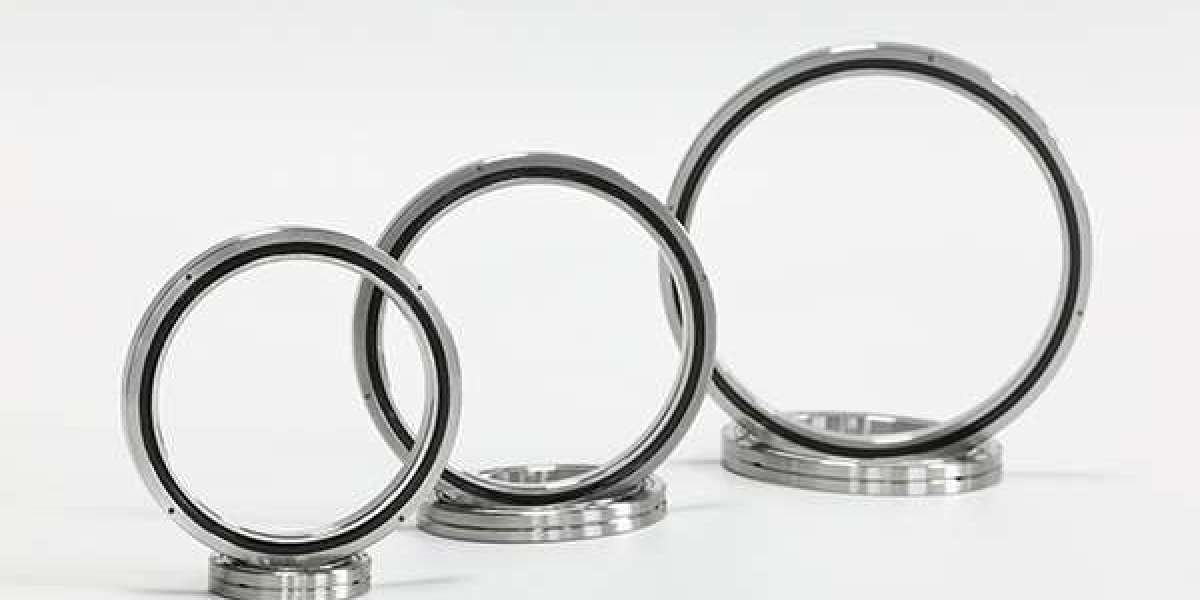

In the current era of automotive engineering, "downsizing" is the primary directive. Whether you are designing the next generation of electric vehicle (EV) power seats, compact lidar scanning units, or lightweight robotic swivels for cabin assembly, you face a relentless challenge: how do you maintain high load capacity when the physical space for components has been slashed by half?
For many B2B design teams, the go-to solution has been thin-section ball bearings. However, as torque requirements increase, these standard bearings often fail under the pressure of moment loads, leading to deflection and mechanical "jitter." To solve this specific engineering bottleneck, the industry is pivoting toward the RA cross roller bearing.
The Problem: The Failure of Thin-Section Ball Bearings in High-Torque Joints
When a rotary joint is subjected to multi-directional forces—radial, axial, and tilting moments—a standard ball bearing relies on a very small point of contact. In a "slim" or thin-section format, this contact point is even smaller.
In a high-intensity automotive production environment, this leads to several critical failures:
Elastic Deformation: Under a tilting moment, the rings of a thin ball bearing can slightly ovalize, leading to inconsistent rotation.
Shortened Fatigue Life: Because the load is concentrated on tiny points, the raceways experience high stress, leading to premature spalling.
Increased Footprint: To handle the same load as a roller-based system, a ball bearing must be significantly larger, defeating the purpose of a compact design.
For procurement managers, these failures manifest as high warranty costs and "unexplainable" precision errors in automated systems.
The RA Series Solution: High Rigidity in a Minimalist Profile
The RA cross roller bearing is a specialized variant designed to provide the highest possible rigidity in the smallest possible cross-section. It features an innovative "split outer ring" design with a solid inner ring, making it the ideal candidate for applications where the inner ring must rotate with extreme precision.
1. Line Contact vs. Point Contact
Unlike ball bearings, the cylindrical rollers in an RA cross roller bearing provide "line contact." This significantly increases the contact area, allowing the bearing to support much higher loads than a ball bearing of the same dimensions. This is the secret to achieving "big bearing" performance in a "small bearing" space.
2. The Integrated Spacer Advantage
To prevent the rollers from friction-locking or skewing, the RA series utilizes individual spacers between each roller. This ensures smooth rotation even under high-speed oscillations, a common requirement in automotive sensor positioning and robotic joints.
Technical Performance Metrics for B2B Sourcing
When integrating the RA cross roller bearing into a new product line, the "sticker price" is only one part of the equation. Automotive experts look at the Stiffness-to-Weight Ratio and Rotational Accuracy.
| Feature | Impact on Automotive Systems | B2B Value Proposition |
| Slim Cross-Section | Fits into narrow housings and joints. | Enables sleeker, lighter product designs. |
| High Rotation Accuracy | Inner ring run-out is minimized. | Critical for high-definition optical sensors. |
| Multi-Load Handling | Supports radial, axial, and moments. | Replaces two bearings with one unit. |
| Custom Preloading | Factory-set for zero clearance. | Eliminates vibration and mechanical noise. |
Solving the "Weight vs. Strength" Dilemma in EV Actuators
As we look toward the 2026 automotive landscape, the weight of every component is under scrutiny to maximize EV range. However, components like electronic power steering (EPS) and active suspension actuators require immense strength.
The RA cross roller bearing allows engineers to "cheat" the traditional weight-to-strength curve. By utilizing the RA series, a design team can reduce the weight of a rotary sub-assembly by up to 40% while actually increasing its resistance to tilting moments. This reduction in unsprung mass or cabin weight directly contributes to vehicle efficiency—a key selling point in the B2B supply chain.
The Procurement Perspective: Strategic ROI
From a B2B purchasing standpoint, the RA series offers a unique "Value Engineering" opportunity. While a specialized roller bearing represents a higher initial investment than a commodity ball bearing, the system-level savings are substantial:
Reduced Machining: Because the RA bearing is so rigid, the surrounding housing doesn't need to be as "beefy" to support the load.
Simplified Assembly: Replacing a duplex ball bearing set with a single RA cross roller bearing reduces the part count and the time required for alignment and shimming.
Maintenance Longevity: The line-contact geometry reduces surface stress, often doubling the service life of the joint in high-cycle applications.
Conclusion
The future of automotive design belongs to those who can do more with less. The RA cross roller bearing is the ultimate tool for this philosophy, providing a bridge between the need for extreme compactness and the demand for unyielding mechanical rigidity.
By transitioning from traditional rolling elements to the RA series, you aren't just buying a bearing; you are enabling a more sophisticated, lighter, and more reliable machine. In the competitive B2B marketplace, that's not just an engineering choice—it’s a strategic advantage.