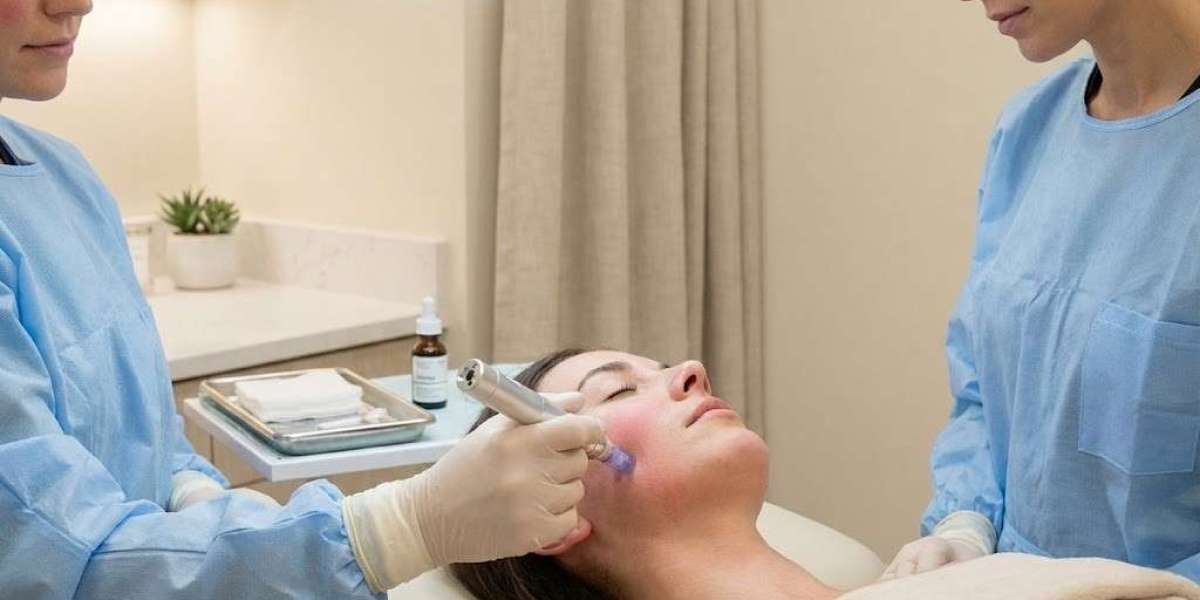

The contemporary patient exploring sagging skin treatment encounters a spectrum of options from conservative to aggressive. Microneedling occupies a unique position within this range—minimally invasive yet biologically potent, simple in concept yet sophisticated in execution. Its growing popularity reflects increasing appreciation for treatments that work with rather than against natural physiology.
Understanding microneedling requires looking past the mechanical action to the cellular cascades it initiates. For those with appropriate presentations, these biological responses can restore structural integrity that years of aging have degraded.
Let us examine how controlled injury becomes therapeutic transformation.
The structural degradation of facial aging
Skin sagging emerges from accumulated molecular damage spanning decades. Fibroblasts—the matrix-producing cells—decrease in number and enter replicative senescence. Their synthetic output drops precipitously. Mitochondrial efficiency declines, generating reactive oxygen species that further damage cellular components.
The extracellular matrix suffers parallel deterioration. Collagen synthesis slows while matrix metalloproteinases accelerate degradation. Elastin networks fragment and lose elastic recoil. Advanced glycation end-products create dysfunctional cross-links. Hyaluronic acid content diminishes, reducing tissue turgor.
These changes collectively thin the dermis and destroy its organized architecture. Skin loses resistance to gravitational deformation. Contours soften. Folds form. The face transitions from defined structure to draped tissue.
The therapeutic precision of micro-injury
Microneedling employs devices fitted with surgical-grade stainless steel or polymer needles. These create controlled perforations ranging from 0.5 to 2.5 millimeters in depth, penetrating the epidermis into the papillary and reticular dermis.
The distribution of these injuries proves critical. Thousands of microscopic wounds, appropriately spaced, create widespread biological signaling while preserving tissue integrity. The epidermis maintains barrier function. Recovery proceeds rapidly despite extensive stimulation.
Each micro-channel initiates wound healing: platelet activation releases growth factors; inflammatory cells clear debris and signal repair; fibroblasts migrate, proliferate, and synthesize new matrix. This cascade continues for months after visible healing completes.
Reconstructing dermal architecture
Collagen provides skin's mechanical strength—resistance to stretching and deformation. Type I collagen forms thick, organized bundles bearing tensile loads. Type III collagen supports finer architecture. Their organized arrays create the scaffold maintaining facial contours.
Aging reduces collagen quantity, disorganizes its structure, and creates pathological cross-links. The result is skin lacking both strength and flexibility—unable to resist gravitational descent.
Microneedling temporarily reverses this decline. The wound healing response demands emergency collagen synthesis. Fresh fibers integrate with existing matrix in functional, organized arrays. Over multiple treatments, this process measurably thickens the dermis and restores mechanical properties.
Clinical applications and technique adaptation
Practitioners apply microneedling to regions demonstrating early to moderate laxity: the lower face, jawline, neck, and perioral area. Each region requires modification based on tissue thickness, vascularity, and underlying anatomy.
The face generally tolerates deeper treatment due to thicker dermis. The neck demands caution given thinner coverage. The periorbital region requires shortest needles and most precise technique.
Comprehensive evaluation at a qualified aesthetic clinic determines whether presentation reflects primarily dermal thinning or structural descent. This assessment guides whether microneedling serves as standalone sagging skin treatment or requires combination with other modalities.
The patient experience
Standard protocols include topical anesthetic application thirty to sixty minutes pre-procedure. During treatment, patients experience sensations ranging from vibration to mild pressure. Discomfort varies by location and individual sensitivity, generally proving manageable.
Treatment duration ranges from twenty minutes for targeted areas to forty-five minutes for full face. Immediate post-treatment appearance includes uniform redness and mild swelling, occasionally with pinpoint bleeding. These effects peak within hours and resolve substantially within forty-eight hours.
Most patients resume normal activities within two to three days, with makeup possible after twenty-four hours for many.
Timeline of biological transformation
Immediate visible effects are limited to transient edema. True improvement develops through processes requiring weeks.
Collagen synthesis increases within days, but visible firmness typically emerges at three to four weeks as new fibers organize. Maximum improvement develops over three to six months during remodeling.
Protocols generally involve three to six treatments spaced four to six weeks apart. This spacing allows healing between sessions while maintaining momentum. Single treatments rarely produce meaningful laxity improvement.
Outcome parameters by severity
For mild laxity—early jowl formation, subtle neck banding, softening jawline—microneedling produces noticeable improvement. Patients report firmer skin, improved contours, and refreshed appearance. Objective measures confirm increased dermal thickness and elasticity.
Moderate laxity yields more conservative benefits. While quality improves, significantly descended tissue requires additional intervention. Microneedling may complement other procedures or serve as maintenance.
Advanced laxity falls outside standalone indications. Surgical approaches typically prove necessary for meaningful structural correction.
Enhanced protocols and combinations
Progressive aesthetic clinic locations increasingly offer advanced variations. Radiofrequency-assisted microneedling introduces controlled thermal injury, potentially amplifying collagen contraction. This combination shows promise for moderate cases.
Platelet-rich plasma (PRP) supplementation utilizes concentrated autologous growth factors. While evidence varies, many practitioners observe enhanced results. Exosomes and targeted serums may further support regeneration.
These enhancements increase investment. Whether they provide proportional benefit depends on individual presentation.
Safety profile and risk management
Microneedling maintains excellent safety records when performed appropriately. Common effects include transient erythema, edema, dryness, and sensitivity—all resolving within days.
Complications are uncommon. Infection requires pathogen introduction, rare with proper sterilization. Post-inflammatory hyperpigmentation occurs more frequently in darker skin types or with sun exposure during healing. Prolonged erythema represents rare possibilities.
Provider selection significantly influences safety. Established aesthetic clinic locations with medical oversight and rigorous training minimize risks. Patient adherence to post-procedure care further reduces complications.
Maintenance and longevity
Collagen induction creates new tissue, but aging continues. Maintenance treatments prove necessary. Most patients benefit from quarterly to semi-annual sessions following initial series.
External factors dramatically influence duration. Photoprotection prevents ultraviolet degradation. Smoking cessation eliminates oxidative stress. Adequate nutrition supports synthesis. Quality sleep facilitates repair.
Microneedling provides the stimulus; lifestyle choices determine longevity.
Value assessment
Microneedling suits patients seeking gradual, natural improvement without foreign materials or significant downtime. It appeals to those uncomfortable with surgery or injections. It particularly benefits individuals with early laxity.
Those seeking immediate, dramatic transformation will find it insufficient. Individuals with advanced structural changes require alternative approaches.
Value extends beyond tightening. Many report improved texture, reduced pores, enhanced luminosity, and better product absorption.
Concluding perspectives
Microneedling represents a biologically sophisticated sagging skin treatment for appropriate candidates. Through controlled micro-injury and collagen induction, it gradually restores structure and improves mild to moderate laxity.
It cannot substitute for surgical correction or volumetric restoration. However, for collagen-deficient laxity in patients prioritizing natural enhancement, it offers compelling advantages.
Comprehensive consultation at a reputable aesthetic clinic determines suitability. When treatment aligns with biological reality, outcomes appear harmonious and authentic.