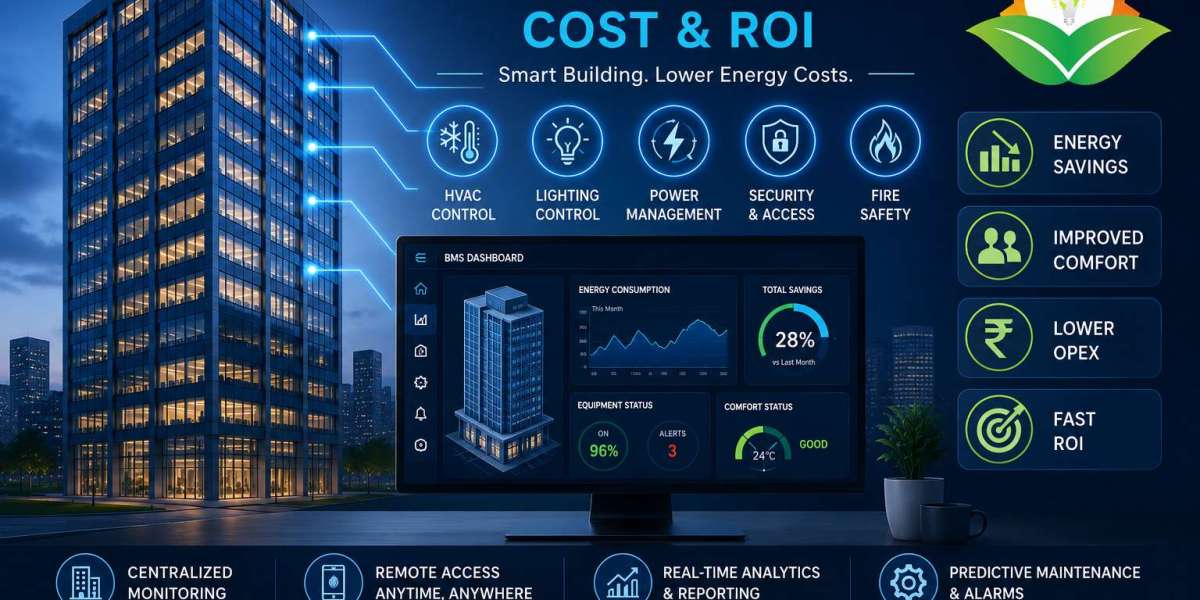

During a peak-hour fire drill at a large hospital complex, the fire alarm triggers and the Building Management System supplies coordinated commands to close fire dampers, isolate HVAC zones, switch stair-pressurization fans, and illuminate evacuation routes. Simultaneously, security locks release selected egress points while CCTV and access logs stream to the operator console. This orchestration prevents smoke spread, preserves safe egress, and gives operations teams a single pane of situational awareness—precisely how a Building Management System improves building safety in real installations.
A Building Management System is the supervisory platform that integrates HVAC , fire, access, power and lighting systems into coordinated control and monitoring. For hospitals, airports, data centers and high-occupancy commercial buildings, that integration is critical: it reduces response time, enforces safety interlocks, and provides auditable event histories. This article describes the safety functions a BMS provides, the engineering principles behind them, and practical considerations for reliable, code-compliant deployments.
How a BMS enhances life‑safety coordination
Centralized alarm aggregation: Instead of siloed alarms on separate panels, the BMS aggregates fire, HVAC, and security events on a single dashboard so operators rapidly understand event scope and priority.
Automated interlocks and sequences: The BMS executes predefined safety sequences—shutting dampers, isolating AHUs, activating smoke extraction fans—ensuring timely, repeatable actions during incidents.
Role-based escalation: Alarm routing and escalation to operations, security and on-call engineers reduces human delay and directs the right responders with the right information.
Historical logging and forensics: Time-stamped event logs and trend archives support incident investigations, regulatory reporting, and corrective actions.
Specific safety integrations and benefits
Fire and smoke control: BMS coordinates with fire panels to close fire/smoke dampers, start smoke extraction fans, and manage pressurization systems. The supervisory layer ensures commands do not inadvertently create smoke paths or compromise protected areas.
HVAC isolation for infection control: In hospitals, BMS manages negative‑pressure isolation rooms and laboratory exhausts, maintaining pressure differentials and tracking door events to limit pathogen spread.
Emergency lighting and egress management: BMS links lighting control with fire systems to illuminate evacuation routes and can sequence stair pressurization and smoke control to maintain safe escape paths.
Access control during incidents: The BMS correlates access events with alarms—unlocking routes for evacuations while maintaining secure zones when required by protocol.
Power resilience and generator sync: Supervisory control monitors critical power paths and can orchestrate prioritized load shedding, transfer to generators, and staged restoration to protect life-safety systems and critical loads such as data center BMS system equipment.
HVAC and thermal protection for critical assets: BMS prevents thermal excursions in data halls by coordinating CRAC/CRAH units, chilled‑water valves and alarms to avoid equipment outages.
Real-time monitoring and predictive safety
Continuous diagnostics: BMS monitors actuator health (damper/valve positions, actuator torque), air flow sensors and water flow meters to detect degraded safety components before failure.
Predictive maintenance: Trend analysis identifies components trending toward failure—stuck dampers, slow-operating smoke fans—allowing proactive replacement through BMS maintenance services.
Threshold-based alerts: Smart thresholds and correlated alarms reduce nuisance alerts while ensuring genuine hazards escalate quickly.
Design and engineering best practices for safety
Keep life‑safety systems segregated: Fire alarm panels and critical safety interlocks should maintain independent primary action with the BMS used for supervision and coordination, not as a single point of control.
Fail‑safe defaults: Design actuators and controllers to go to a safe state on loss of supervisory link or power—eg, gravity‑closed dampers or spring return actuators where code requires.
Redundancy and resilience: Critical sites require redundant BMS control panels , historians and network paths to ensure supervisory capability during hardware faults.
Verified sequences and FAT/SAT: Factory acceptance tests and site acceptance tests must validate safety sequences, interlocks and correct HMI alarms before handover.
Cybersecurity and hardening: Segmented control networks, role-based access and secure remote access prevent malicious interference that could undermine safety functions.
Applications where BMS safety value is highest
Hospitals and healthcare: Infection control, isolation management, and rapid response to HVAC or fire events.
Data centers: Protecting critical thermal envelopes and coordinating power and cooling responses.
Airports and transit hubs: Managing smoke control across large concourses and coordinating security responses.
Industrial plants: Integrating process shutdowns, ventilation and emergency isolation with safety instrumentation.
High‑rise office buildings and malls: Centralized evacuation management, power prioritisation and supervised lighting control.
Buyer considerations and operational readiness
Require documented integration plans and FAT/SAT proof from your BMS company .
Insist on open protocols to integrate diverse fire, access and HVAC systems reliably.
Includes training and drills for operations teams to practice coordinated responses using the BMS control panel.
Factor BMS system installation and AMC scope to include periodic safety validation, actuator cycling and firmware patching.
Common mistakes to avoid
Treating the BMS as the primary life-safety controller instead of a supervisory coordinator.
Skipping full FAT/SAT validation of safety sequences.
Neglecting actuator health monitoring, which allows critical dampers or valves to seize unnoticed.
Overlooking cybersecurity, which can create exploitable pathways into safety-related functions.
Conclusion
A Building Management System significantly improves building safety by centralizing alerts, enforcing automated safety sequences, enabling rapid escalation, and supporting predictive maintenance. When engineered with independent life-safety controls, fail-safe design, redundancy, and rigorous testing, a BMS becomes an invaluable ally in protecting occupants, assets and mission-critical operations. Plan BMS system installation with safety-first architecture, validated commissioning, and ongoing BMS maintenance services to ensure resilient, auditable, and effective life-safety performance across your facility.