
Growth Without Guardrails
The growth trajectory of a successful e-commerce marketplace can be intoxicating. Transaction volumes climbing month over month, seller numbers expanding rapidly, geographic reach extending into new markets — these are the metrics that attract investment, generate press coverage, and validate the platform's market thesis. But rapid growth without proportionate investment in verification and compliance infrastructure is a fundamentally unstable trajectory. The fraud, defaults, and reputational incidents that inadequate controls enable do not scale linearly with transaction volume — they scale superlinearly, because each new unverified seller represents a risk multiplier that compounds across every transaction they execute on the platform.
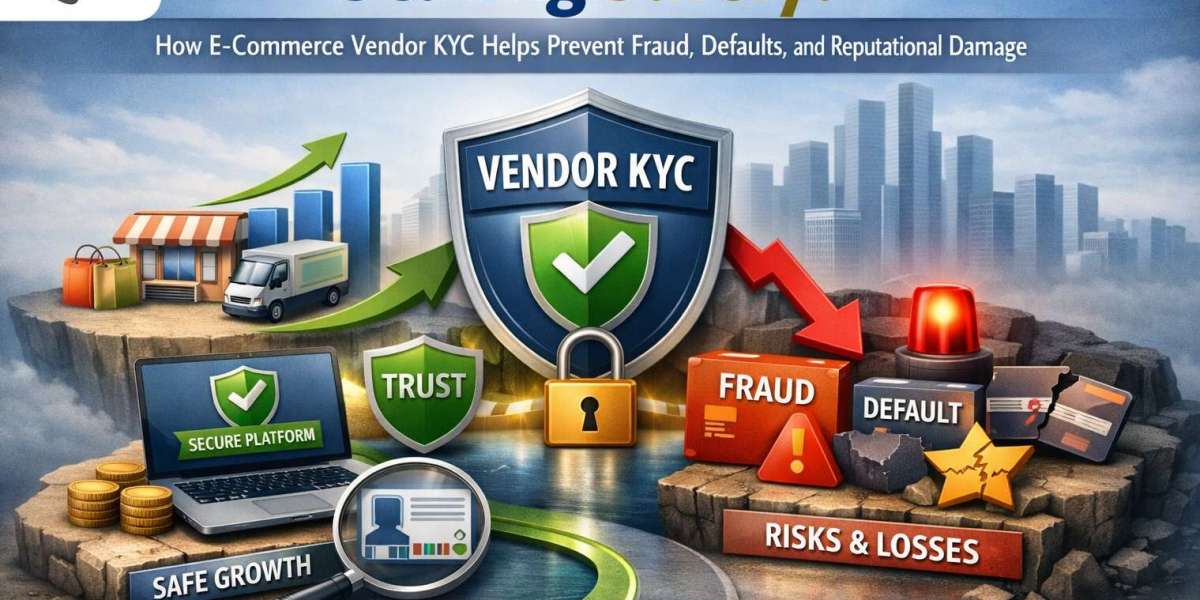
E-commerce vendor KYC is the mechanism through which sustainable scaling is achieved. It is not a brake on growth — it is the guardrail that allows the platform to accelerate confidently, knowing that the vendor population it is scaling with has been verified, assessed, and is subject to ongoing monitoring that will detect problems before they become platform-wide crises.
The Three Scaling Risks That KYC Addresses
As an e-commerce platform scales, three categories of risk grow with it, each of which robust vendor KYC directly mitigates.
Fraud risk is the most immediate. Every fraudulent vendor onboarded onto the platform is a potential source of buyer losses, dispute costs, and reputational damage. At small scale, individual fraud incidents are manageable. At large scale, a systematic weakness in vendor verification creates structural fraud exposure whose aggregate impact can be severe. E-commerce KYC reduces the population of fraudulent vendors who successfully gain platform access, directly limiting the fraud losses that scale would otherwise amplify.
Default risk is less visible but equally damaging. Vendors who collect payments from buyers without the financial stability or operational capacity to fulfil their orders reliably create default incidents that erode buyer trust, generate costly dispute resolution processes, and expose the platform to liability under consumer protection regulations. Vendor KYC that incorporates financial assessment — including basic checks on business viability and financial health — reduces the onboarding of vendors whose default risk is elevated from the outset.
Reputational risk is the most consequential at scale. A single high-profile incident — a major counterfeit product scandal, a fraud scheme affecting large numbers of buyers, a regulatory enforcement action triggered by inadequate compliance controls — can cause reputational damage that takes years to repair. At scale, the reputational consequences of inadequate vendor verification are not proportionate to the incident; they are amplified by platform size, media attention, and regulatory scrutiny that larger platforms inevitably attract.
Building a KYC Infrastructure That Scales
The practical challenge for growing platforms is building vendor KYC infrastructure that scales with the business without creating operational bottlenecks. Manual verification processes that work adequately at a few hundred vendor onboardings per month become completely unmanageable at thousands per day. The solution lies in automation — technology-driven verification workflows that handle the majority of verifications without human intervention, reserving manual review for the cases that genuinely require it.
Automated global seller identity verification platforms can process identity documents, perform facial biometric matching, query business registries across dozens of jurisdictions, and screen against global watchlists and sanctions databases — all within minutes, at any volume. The risk-tiered model described earlier in this article series applies here with particular force: automating standard-risk verifications completely while routing elevated-risk cases to manual review creates a scalable architecture that maintains verification quality as volume grows.
Ongoing Monitoring: KYC as a Continuous Process
Merchant identity verification at the point of onboarding is necessary but not sufficient for a platform that is serious about managing vendor risk at scale. Vendors whose profiles were clean at onboarding can deteriorate over time — becoming subject to sanctions, exhibiting fraud patterns, defaulting on financial obligations, or changing their beneficial ownership in ways that would have triggered enhanced scrutiny if they had been present at the original application.
Ongoing monitoring — periodic re-verification of high-risk vendors, continuous screening against updated sanctions and watchlist databases, and automated detection of transaction patterns that deviate from the vendor's established profile — converts KYC from a point-in-time exercise into a continuous risk management capability. This ongoing dimension of vendor KYC for online platforms is what distinguishes platforms that genuinely manage vendor risk from those that simply check boxes at onboarding.
The Regulatory Imperative for Scaling Platforms
Regulatory scrutiny of e-commerce marketplace platforms increases with platform size. Small platforms may operate beneath the regulatory radar; large ones are squarely within it. As platforms scale, they become subject to increasingly demanding regulatory requirements — AML obligations, consumer protection requirements, tax reporting mandates, and in some jurisdictions explicit marketplace seller verification requirements. Building compliance-grade vendor KYC infrastructure before regulatory requirements compel it is consistently less costly and disruptive than retrofitting compliance onto a platform that has scaled without it.
Conclusion
Scaling safely is not a compromise between growth and integrity — it is the recognition that sustainable growth requires both. E-commerce vendor KYC is the infrastructure that makes safe scaling possible: reducing fraud at the source, limiting default exposure, protecting platform reputation, and building the regulatory compliance foundation that large-scale operations require. Platforms that invest in robust vendor verification as they scale are not just managing risk — they are building the structural integrity that transforms a fast-growing marketplace into a durable, trusted platform. In e-commerce, trust is the ultimate competitive moat, and KYC is how it is built.